

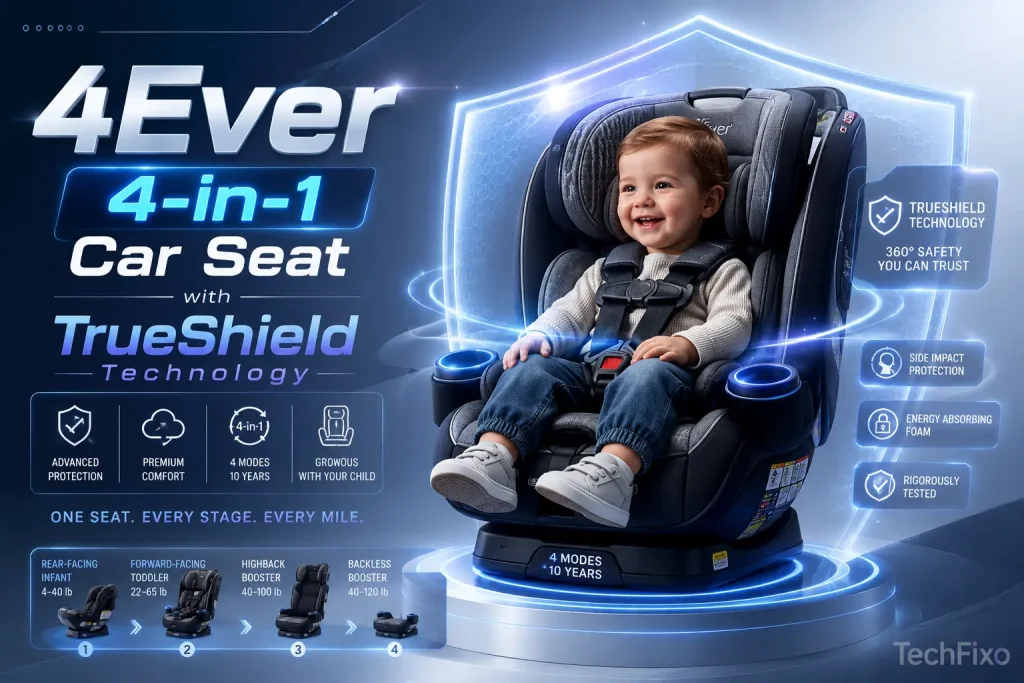
Choosing a child car seat can feel complicated because parents must think about safety, comfort, installation, vehicle compatibility and how quickly a child will outgrow the seat. The 4Ever 4-in-1 Convertible Car Seat featuring TrueShield Technology is designed to simplify that decision by combining four seating stages into one long-term child restraint.
The Graco 4Ever TrueShield car seat begins as a rear-facing seat for babies, converts into a forward-facing harness seat for toddlers and preschoolers, and later changes into high-back and backless booster modes. Its main distinguishing feature is TrueShield Technology, which Graco describes as side-impact protection extending from the child’s head to hips.
This combination of multiple seating modes, adjustable components and added side protection makes the seat appealing to families looking for a product that can remain useful through several stages of childhood. However, its long lifespan does not mean parents can install it once and forget about it. Each mode has different weight limits, harness settings and installation requirements that must be followed carefully.
What Is the 4Ever 4-in-1 Convertible Car Seat?
The 4Ever 4-in-1 Convertible Car Seat featuring TrueShield Technology is an all-in-one child car seat manufactured by Graco. It is built to transition through four configurations as a child grows.
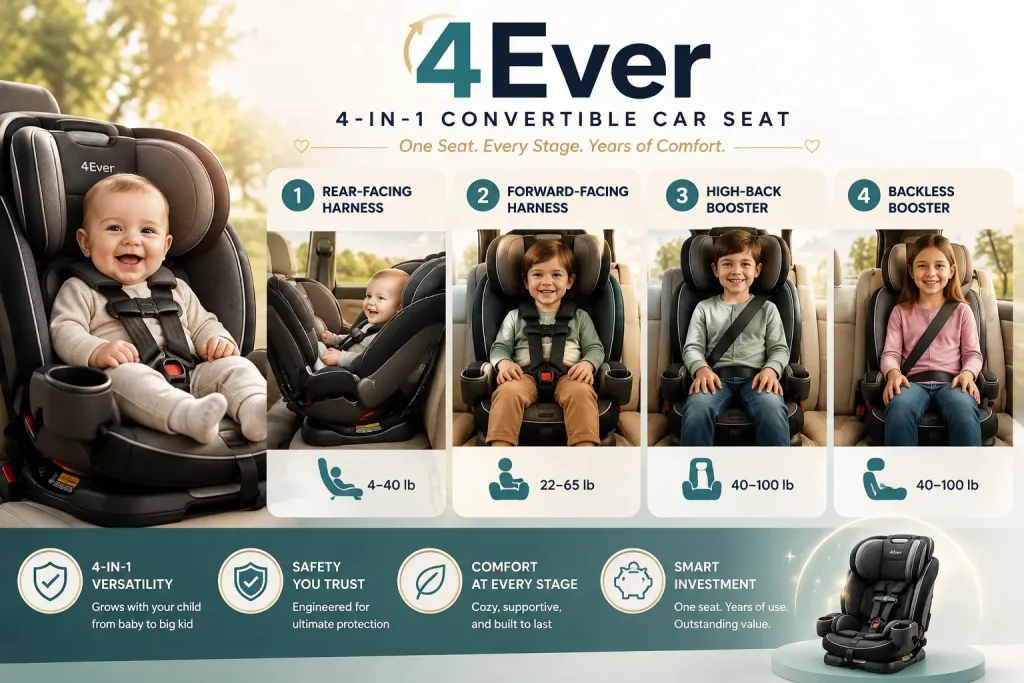
These four modes are:
- Rear-facing infant car seat
- Forward-facing seat with a five-point harness
- High-back belt-positioning booster
- Backless belt-positioning booster
Unlike a traditional infant carrier, this model is intended to remain installed in the vehicle. It does not detach from a separate base for carrying a baby outside the car.
The main benefit of this design is continuity. Instead of purchasing a separate rear-facing seat, toddler seat, high-back booster and backless booster, parents may be able to use one car seat across all four stages, provided the child remains within the manufacturer’s stated limits and the seat continues to fit the vehicle correctly.
4Ever 4-in-1 Car Seat Weight Limits
The Graco 4Ever TrueShield is designed for children ranging from 4 to 120 pounds, but that range is divided across four different modes.
| Car Seat Mode | Child Weight Range | Restraint Type |
|---|---|---|
| Rear-facing infant mode | 4–40 lb | Five-point harness |
| Forward-facing harness mode | 22–65 lb | Five-point harness and tether |
| High-back booster mode | 40–100 lb | Vehicle lap-and-shoulder belt |
| Backless booster mode | 40–120 lb | Vehicle lap-and-shoulder belt |
These ranges overlap, but reaching the minimum weight for the next stage does not automatically mean a child should move to it.
For example, a child reaching 22 pounds does not need to change immediately from rear-facing to forward-facing. National child passenger safety guidance recommends keeping children rear-facing until they reach the maximum rear-facing height or weight allowed by their specific car seat. Similarly, children should remain in the forward-facing harness until they outgrow that mode before moving into a booster.
Parents should use the child’s weight, height, maturity and the instructions printed on the seat and in its manual when deciding when to change modes.
What Is TrueShield Technology?
TrueShield Technology is the side-impact protection system used in this version of the Graco 4Ever car seat.
Graco describes the system as providing protection from the child’s head to hips during a side-impact event. The seat includes protective structures around the headrest and sides of the seating area to create a more enclosed protective zone around the child.
Side-impact protection is important because side collisions can place substantial forces close to an occupant. In a child restraint, the surrounding shell, head support, harness and energy-managing materials work together to help manage movement.
What TrueShield Technology Does Not Mean
TrueShield should not be interpreted as a guarantee that injury cannot occur during a collision. No car seat can remove every risk associated with a serious crash.
The effectiveness of any child restraint also depends on:
- Selecting the correct mode for the child
- Installing the seat tightly
- Routing the belt or lower anchors correctly
- Using the top tether when required
- Positioning the harness properly
- Tightening the harness sufficiently
- Following both the car seat and vehicle manuals
- Replacing or evaluating the seat when required after a crash
- Checking recalls and expiration information
TrueShield is an added design feature, but correct daily use remains essential.
How the Four Car Seat Modes Work
The value of the Graco 4Ever 4-in-1 car seat comes from its ability to change as a child’s restraint needs develop.
Rear-Facing Infant Mode
In rear-facing mode, the child sits facing the back of the vehicle and is secured by the integrated five-point harness.
The seat supports children from 4 to 40 pounds in this configuration. Rear-facing positioning helps support the child’s head, neck and spine by allowing the car seat shell to manage crash forces across a larger area of the body.
This mode is suitable for newborns who meet the seat’s minimum requirements, babies and toddlers who remain within the approved rear-facing limits.
Parents should not rush to turn the seat forward-facing simply because a child’s legs bend or touch the vehicle seat. Children can generally find comfortable positions for their legs while remaining rear-facing.
Rear-Facing Harness Position
When the seat is rear-facing, the harness straps should generally come from at or below the child’s shoulders. The chest clip should sit around armpit level, and the harness should be snug enough that excess webbing cannot be pinched at the shoulder.
Parents must also check that the seat is reclined at an approved angle and that the child has the required space above the head according to the model-specific instructions.
Forward-Facing Harness Mode
After the child reaches the rear-facing height or weight limit, the seat can be converted to forward-facing harness mode.
This configuration is designed for children weighing between 22 and 65 pounds. The child remains secured with the seat’s five-point harness, while the car seat faces the front of the vehicle.
When used forward-facing, the top tether is an important part of the installation. It connects the upper portion of the car seat to the vehicle’s tether anchor and helps limit forward movement during a sudden stop or collision.
NHTSA recommends using the tether with a forward-facing car seat when permitted by the car seat and vehicle manufacturers.
Forward-Facing Harness Position
For forward-facing use, the harness straps should normally be positioned at or just above the child’s shoulders.
Parents must make sure they are using the forward-facing belt path rather than the rear-facing belt path. They should also confirm whether installation is being completed with the vehicle seat belt or lower anchors and whether the child has reached the lower-anchor weight limit.
The seat belt and lower anchors should not be used together unless the manufacturer specifically permits that method.
High-Back Booster Mode
The high-back booster configuration is intended for children weighing between 40 and 100 pounds who have outgrown the forward-facing harness and are mature enough to sit correctly throughout the journey.
In booster mode, the integrated harness is no longer used. Instead, the vehicle’s lap-and-shoulder belt secures the child.
The high back helps position the shoulder belt and provides head and torso support. This mode may be especially useful in vehicles with low seat backs or head restraints that do not adequately support the child.
A child should be able to remain seated upright without leaning, slouching, moving the shoulder belt behind the back or placing it under the arm.
Backless Booster Mode
The final configuration is the backless booster, designed for children weighing between 40 and 120 pounds.
The booster raises the child so the vehicle seat belt fits across stronger areas of the body. The lap belt should rest low across the upper thighs rather than the stomach, while the shoulder belt should cross the middle of the chest and shoulder.
A backless booster should be used only where the vehicle provides appropriate head support. If the vehicle seat back or head restraint does not reach high enough to support the child’s head, the high-back booster configuration may be more appropriate.
Children should continue using a booster until the vehicle seat belt fits correctly without one. This often occurs when a child is approximately 4 feet 9 inches tall, although body proportions and vehicle seat design also affect belt fit.
Key Features of the Graco 4Ever TrueShield Car Seat
The 4Ever 4-in-1 Convertible Car Seat featuring TrueShield Technology includes several features intended to make long-term use more practical.
Simply Safe Adjust Harness System
The Simply Safe Adjust Harness System allows the harness height and headrest to move together.
This means parents do not have to remove and manually rethread the harness straps each time the child grows. Adjusting both components in one motion can make it easier to maintain a suitable harness position.
Although the system reduces rethreading, parents must still check the harness height regularly. Children can grow quickly, and a position that fit correctly a few months ago may no longer be appropriate.
Ten-Position Adjustable Headrest
The one-hand adjustable headrest offers ten positions.
A greater number of headrest positions helps the seat adapt to changes in the child’s torso height. The correct position depends on whether the seat is rear-facing, forward-facing or being used as a booster.
The headrest should not be positioned for comfort alone. It must also support correct harness or seat belt placement.
Six-Position Recline
The six-position recline allows parents to adjust the seat angle for different modes, children and vehicle seating surfaces.
Recline settings can help:
- Achieve an approved rear-facing angle
- Support a younger child’s head
- Improve installation in sloped vehicle seats
- Provide a more suitable forward-facing position
- Increase comfort during longer journeys
Not every recline setting can be used in every mode. Parents should check the indicator and instruction manual rather than selecting an angle based only on appearance.
InRight LATCH System
The InRight LATCH connectors are designed to attach to compatible lower anchors in the vehicle.
Graco describes the system as providing a quick connection with an audible click. The click confirms that the connector has attached, but parents must still tighten the installation and test movement at the correct belt path.
Lower anchors also have weight limits. Once the applicable limit is reached, the seat may need to be installed using the vehicle seat belt instead.
Steel-Reinforced Frame
The car seat uses a steel-reinforced frame intended to provide structural strength and durability through years of use.
Because this is a long-term seat with multiple modes, the frame must support repeated adjustment and regular family travel. However, the seat should still be inspected periodically for damage, missing parts, wear or signs that it has been involved in a crash.
Removable, Washable Cover
The seat cover can be removed for cleaning without completely removing the harness.
This is valuable for a seat that may be used from infancy through the booster years. Spills, crumbs and motion sickness can make regular cleaning necessary.
Parents should follow Graco’s cleaning instructions carefully. Strong chemicals, bleach, unapproved lubricants or incorrect washing methods may damage the cover, harness or plastic components.
Integrated Cup Holders
The car seat includes cup holders for drinks, snacks or small travel items.
Cup holders can be convenient during longer journeys, but hard, sharp or heavy objects should not be stored where they could become projectiles during sudden braking or a crash.
Graco 4Ever TrueShield Specifications at a Glance
| Feature | Details |
|---|---|
| Seat type | All-in-one convertible car seat |
| Number of modes | Four |
| Overall child weight range | 4–120 lb |
| Rear-facing limit | 4–40 lb |
| Forward-facing harness limit | 22–65 lb |
| High-back booster limit | 40–100 lb |
| Backless booster limit | 40–120 lb |
| Headrest positions | 10 |
| Recline positions | 6 |
| Harness adjustment | No-rethread Simply Safe Adjust system |
| Lower-anchor system | InRight LATCH |
| Side protection | TrueShield Technology |
| Frame | Steel reinforced |
| Product weight | Approximately 24 lb |
| Cover | Removable and washable |
| Intended use | Long-term seat from baby through booster stages |
Graco markets the seat as providing up to ten years of use. Actual usable time depends on the manufacture date, expiration date, the child’s growth, condition of the seat, vehicle compatibility and whether every mode provides a correct fit.
Benefits of the 4Ever 4-in-1 Convertible Car Seat
One Seat for Multiple Growth Stages
The most obvious benefit is that the car seat can be used across four stages.
This may reduce the need to research and purchase a new child restraint each time the child outgrows a mode. Parents can also become familiar with one adjustment system instead of learning an entirely different seat every few years.
Long-Term Value
Although an all-in-one car seat may cost more initially than a basic infant or convertible seat, it can offer strong long-term value when used through several modes.
Value should not be measured only by purchase price. Parents should also consider:
- Number of years the seat may be used
- Whether another booster will be needed
- Ease of cleaning
- Ease of adjustment
- Vehicle fit
- Availability of replacement parts
- Comfort for the child
- Convenience for caregivers
A lower-cost seat that is difficult to install or outgrown quickly may not always provide better overall value.
Reduced Harness Adjustment Work
The no-rethread harness can save time as a child grows.
Traditional rethread harnesses require straps to be removed from one set of slots and routed through another. A combined headrest and harness adjustment system reduces this process and may encourage parents to correct the harness height more frequently.
Added Side Coverage
TrueShield Technology is intended to provide additional protection around the child’s head and torso.
The enclosed design can also create a supportive seating area, particularly for younger children. However, a more enclosed structure may make the seat feel wide in smaller vehicles, so parents should test vehicle compatibility.
Familiarity Across Modes
Using one seat for several years allows both the child and caregivers to become familiar with its controls, buckle, harness and installation features.
This can be helpful in households where grandparents, babysitters or multiple caregivers regularly transport the child.
However, familiarity should not lead to complacency. The instructions change when the seat converts between modes.
Possible Drawbacks to Consider
No child car seat is ideal for every family or every vehicle.
It Is Heavier Than a Basic Car Seat
At approximately 24 pounds, the Graco 4Ever TrueShield is not designed for frequent carrying.
It may be less convenient for families who regularly move a seat between multiple vehicles, use taxis, travel by air or rely on rideshare transportation.
It Can Take Up Significant Space
All-in-one seats are often larger than basic convertible or booster seats.
Rear-facing installation may require substantial front-to-back space. The side protection, headrest and cup holders can also affect how well the seat fits beside other passengers or child restraints.
Families attempting to install three car seats across one row should measure carefully and test the exact arrangement.
It Does Not Replace an Infant Carrier
Although the seat can accommodate small babies who meet its requirements, it does not provide the convenience of a removable infant carrier.
Parents cannot lift the entire seating shell out of the vehicle and attach it to a stroller. Families who value that convenience may prefer to begin with a rear-facing infant carrier and move to the 4Ever later.
One Seat May Not Be Ideal in Every Mode
A seat that performs several jobs offers versatility, but individual children and vehicles may fit differently in each configuration.
For example, a family may like the seat in harness mode but find that a dedicated booster provides a better belt fit in a particular vehicle. Parents should evaluate the fit at every transition rather than assuming the next mode will automatically be suitable.
Installation Still Requires Care
Features such as InRight LATCH and a level indicator can make installation easier, but they do not make it automatic.
The parent must still choose the correct belt path, installation method, recline position and tether arrangement.
Graco 4Ever TrueShield Pros and Cons
| Pros | Cons |
|---|---|
| Four seating modes in one product | Heavier than many basic car seats |
| Supports children from 4 to 120 lb | Can be bulky in compact vehicles |
| TrueShield side-impact protection | Not a detachable infant carrier |
| Ten-position adjustable headrest | May be difficult to move frequently |
| No-rethread harness adjustment | Correct setup changes between modes |
| Six recline positions | May not fit three-across arrangements |
| Steel-reinforced frame | Higher initial cost than basic models |
| Removable washable cover | Vehicle fit must be tested |
| High-back and backless booster modes | One seat may not provide the best fit in every stage |
How to Install the Graco 4Ever TrueShield Correctly
The exact installation procedure depends on the mode being used, the child’s size and the vehicle.
The car seat manual and vehicle owner’s manual should always be read together.
Choose the Correct Seating Position
Children should generally ride in the rear seat of the vehicle.
The center rear position may provide benefits in some vehicles, but only when the car seat can be installed tightly and the vehicle manufacturer permits the chosen installation method in that position.
The best location is a rear seating position where:
- The seat fits correctly
- The installation can be tightened properly
- The required anchors are available
- The front seats can be used safely
- The caregiver can secure the child correctly every time
Use Either Lower Anchors or the Seat Belt
Install the harnessed car seat using the lower anchors or the vehicle seat belt according to the manuals.
Do not use both systems simultaneously unless Graco specifically permits it for the exact model and mode.
The installation should not move more than approximately one inch from side to side or front to back when tested at the belt path.
Attach the Top Tether When Forward-Facing
When the seat is forward-facing, connect the top tether to the correct vehicle tether anchor when allowed.
Do not attach it to a cargo hook or another part that merely resembles a tether anchor. The vehicle manual identifies the approved anchor location.
Check the Recline Indicator
Use the appropriate recline setting and confirm the angle with the seat’s indicator.
Rear-facing babies require an approved angle that supports the head and keeps the airway positioned correctly. Forward-facing and booster modes may require more upright settings.
Perform a Final Harness Check
Before every journey, check that:
- The harness is flat and not twisted
- The straps are at the correct shoulder level
- The buckle is fully connected
- The chest clip is at armpit level
- The harness is snug
- Bulky coats are not underneath the harness
- The child remains within the mode’s limits
Common Mistakes to Avoid
Turning the Child Forward-Facing Too Soon
The minimum forward-facing weight is not a recommendation to turn the child at that exact point.
Keep the child rear-facing until the rear-facing limit is reached, provided the child still fits according to the manual.
Moving to Booster Mode Based Only on Weight
A child may meet the minimum booster weight but still be too young or not behaviorally ready.
Booster riders must remain seated correctly for the entire trip. A child who leans, slouches or moves the shoulder belt may still need a harnessed seat.
Using the Wrong Belt Path
Convertible seats have different belt paths for rear-facing and forward-facing installation.
Routing the seat belt or lower-anchor strap through the wrong path can result in an unsafe installation.
Leaving the Harness Too Loose
A loose harness may not properly control the child’s movement during a crash.
After tightening, parents should not be able to pinch excess harness webbing at the shoulder.
Using Unapproved Accessories
Extra head supports, strap covers, seat protectors or padding may interfere with the restraint unless they came with the seat or are specifically approved by Graco for that model.
AAP guidance advises against adding products that were not supplied or approved for the specific car seat.
Ignoring Lower-Anchor Weight Limits
Lower anchors are not always approved for the full forward-facing harness range.
Parents must check the car seat label, manual and vehicle instructions to know when to switch from lower-anchor installation to a vehicle seat belt installation.
Forgetting to Register the Car Seat
Registration allows the manufacturer to contact the owner about recalls and safety notices.
Parents should complete the registration card or register the car seat through the manufacturer’s official process.
Cleaning and Maintenance
Regular cleaning helps maintain comfort and prevents buckle or harness problems caused by crumbs and sticky liquids.
Cleaning the Cover
Remove the cover according to Graco’s instructions and wash it only using the approved method.
Do not assume every fabric component can be machine washed or dried. High heat or harsh products may damage materials.
Cleaning the Harness
Harness straps should be cleaned only as directed by the manufacturer.
They should not be soaked, machine washed, ironed or treated with strong cleaning chemicals unless the manual specifically allows it. Damaging the fibers can affect how the harness performs.
Cleaning Plastic and Metal Parts
Graco states that metal and plastic components may be cleaned with mild soap and cool water. The buckle area should be kept free from food, liquids and debris.
Inspecting the Seat
Check the car seat periodically for:
- Cracks or deformation
- Frayed harness straps
- Missing labels
- Damaged buckles
- Loose components
- Signs of heat damage
- Unapproved replacement parts
- Expiration information
- Recall notices
A seat involved in a crash should be handled according to Graco’s instructions and current safety guidance.
Is the 4Ever 4-in-1 Convertible Car Seat Worth It?
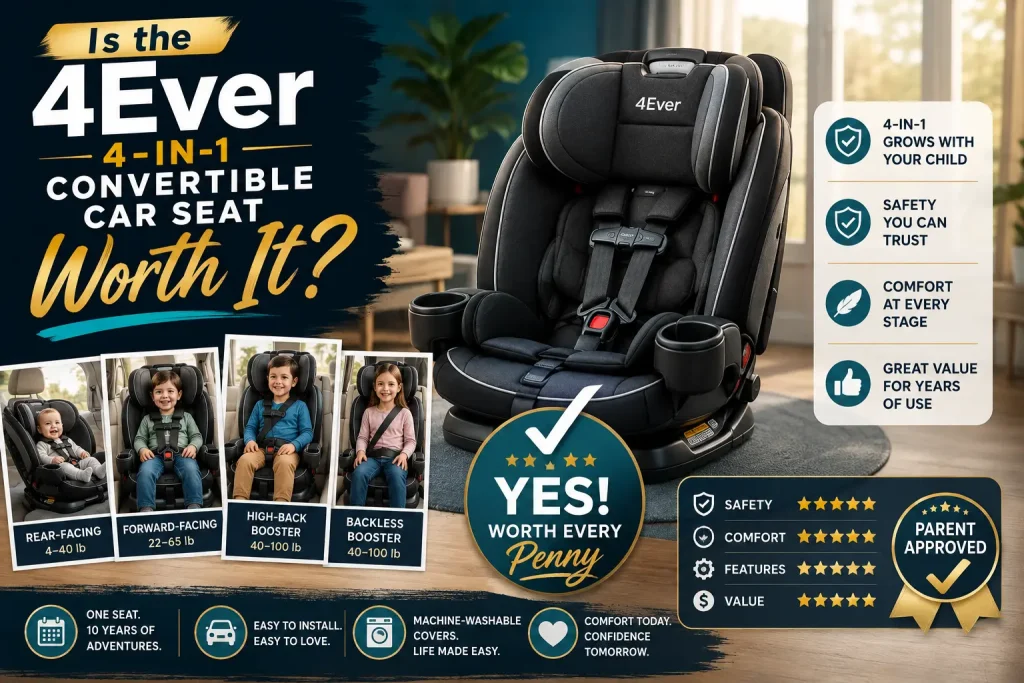
The Graco 4Ever 4-in-1 Convertible Car Seat featuring TrueShield Technology may be worth considering for families who want a long-term child restraint with multiple configurations and added side protection.
It may be particularly suitable for parents who:
- Want one seat that converts from rear-facing to booster use
- Prefer a no-rethread harness
- Value multiple headrest and recline positions
- Plan to leave the seat installed in one primary vehicle
- Want both high-back and backless booster options
- Have enough rear-seat space for an all-in-one model
- Are comfortable learning the requirements for each mode
It may be less suitable for families who:
- Need a lightweight travel car seat
- Frequently transfer the seat between vehicles
- Want a detachable infant carrier
- Have a very compact back seat
- Need to fit three child restraints across one row
- Prefer separate, specialized seats for each growth stage
The best car seat is not simply the one with the most features. It is the seat that fits the child, fits the vehicle and can be installed and used correctly on every journey.
Frequently Asked Questions
What age is the Graco 4Ever TrueShield car seat for?
The seat is designed for multiple stages rather than one fixed age range. It may be used from infancy through the booster years when the child meets the height, weight and fit requirements for the appropriate mode.
What does TrueShield mean on a Graco car seat?
TrueShield is Graco’s side-impact protection system. The company describes it as providing protective coverage from the child’s head to hips during a side-impact event.
Can the Graco 4Ever TrueShield be used for a newborn?
It can be used for a newborn who weighs at least 4 pounds and fits correctly according to the seat’s rear-facing requirements. Parents of premature or very small newborns should confirm that the harness and body position provide an appropriate fit.
Is the Graco 4Ever an infant carrier?
No. It can be used rear-facing for infants, but it is not a detachable carrier. The seat remains installed in the vehicle.
How long can a child remain rear-facing in the Graco 4Ever?
A child can remain rear-facing until reaching the maximum rear-facing height or weight limit specified by Graco. The stated rear-facing weight range is 4 to 40 pounds.
When should the seat be changed to forward-facing?
The seat should be changed only after the child outgrows the rear-facing limits. Reaching the 22-pound minimum for forward-facing mode does not mean the child must immediately be turned forward.
Does the Graco 4Ever TrueShield use a five-point harness?
Yes. The integrated five-point harness is used in rear-facing and forward-facing modes. The harness is removed or stored according to the manual when the seat is converted to booster mode.
Can the Graco 4Ever be installed with a seat belt?
Yes. It can be installed with the vehicle seat belt in harnessed modes when the correct belt path and locking method are used. Parents should follow both manuals carefully.
Can LATCH and the vehicle seat belt be used together?
They should generally not be used together unless the manufacturer specifically approves that installation method for the exact seat and mode.
Does the car seat have a removable cover?
Yes. The cover is designed to be removable and washable. Cleaning instructions should be followed to avoid damaging the cover or restraint components.
Is the Graco 4Ever TrueShield good for small vehicles?
It may fit some small vehicles, but its all-in-one design can require considerable space, particularly when rear-facing. Parents should test the seat in the intended vehicle and check front-seat clearance before purchasing.
Can the Graco 4Ever fit three across?
That depends on the vehicle, neighboring car seats and seating positions. Its side structure and cup holders may make three-across installation difficult in narrower vehicles.
Does the seat expire?
Yes. Car seats have manufacturer-defined expiration periods. Parents should check the date of manufacture, expiration information printed on the seat and the user manual rather than assuming the seat remains usable for ten years from the purchase date.
Can a used Graco 4Ever car seat be purchased safely?
A used seat should be considered only when its full history is known. It should not be expired, recalled, damaged, missing labels or parts, or involved in a crash that requires replacement. The original manual should also be available.
When can the backless booster mode be used?
The child must meet the backless booster requirements, have adequate head support from the vehicle seat and maintain a correct lap-and-shoulder belt position throughout the trip.
Conclusion
The 4Ever 4-in-1 Convertible Car Seat featuring TrueShield Technology combines four child restraint stages in one adjustable design. It can begin as a rear-facing seat for a small baby, transition into a forward-facing five-point harness seat and later function as both a high-back and backless booster.
TrueShield Technology adds side-impact coverage around the child’s head and torso, while the ten-position headrest, no-rethread harness, six recline positions and InRight LATCH system are designed to make everyday adjustments and installation more manageable.
Its greatest strength is long-term versatility. Its main limitations are its weight, size and the need to understand different instructions for each mode. Parents should never move a child to the next configuration simply because the minimum weight has been reached.
When the seat fits the child and vehicle properly and is used according to the manufacturer’s instructions, the Graco 4Ever TrueShield can provide families with a practical, comfortable and adaptable seating solution through several important stages of childhood.