

“Any sufficiently advanced technology is indistinguishable from magic” is one of the most memorable statements about innovation, science and the rthur C. Clarke, the quote describes what happens when people encounter technology far beyond their knowledge or experience.
A smartphone would appear supernatural to someone living several centuries ago. Video calls could look like telepathy, airplanes like impossible flying machines and artificial intelligence like a thinking spirit hidden inside a computer. These technologies are not magical, but their underlying processes are so advanced that an uninformed observer may struggle to distinguish them from magic.
The quote is more than a clever observation about futuristic inventions. It explains the relationship between technological knowledge, human perception and scientific progress. It also warns us that when technology becomes difficult to understand, people may admire, fear or trust it without examining how it actually works.
What Does “Any Sufficiently Advanced Technology Is Indistinguishable from Magic” Mean?
The quote means that advanced technology can appear magical when its operation is beyond the observer’s understanding.
Magic is traditionally associated with results that seem to have no visible physical explanation. A magician says a few words, moves a hand or uses an object, and something unexpected happens. Advanced technology can create a similar experience. A person taps a screen, speaks a command or presses a button, and a complex result appears almost instantly.
The technology is not actually supernatural. It only seems supernatural because most of the system remains invisible.
For example, when someone asks an AI assistant to create an image, translate a paragraph or summarize a document, the result may appear within seconds. The user does not see the computer infrastructure, mathematical models, software systems, training processes and data operations involved. They see only the request and the result.
That gap between visible action and hidden complexity creates the appearance of magic.
Who Said Any Sufficiently Advanced Technology Is Indistinguishable from Magic?
The quote is attributed to British science-fiction writer, inventor and futurist Arthur C. Clarke. It is commonly known as Clarke’s Third Law.
Clarke presented his laws as observations about science, prediction and humanity’s understanding of what is possible. The third law was added to a revised edition of his book Profiles of the Future and became the most widely recognized of the three. own for exploring space travel, communication systems, artificial intelligence and humanity’s future relationship with technology. His work frequently examined the point at which scientific advancement becomes so extraordinary that it changes how people understand reality.
Clarke’s Three Laws
Arthur C. Clarke’s three laws can be summarized as follows:
- When a respected older scientist says something is possible, the scientist is probably right. When the scientist declares it impossible, the scientist may be wrong.
- The only way to discover the limits of what is possible is to move beyond them into what initially appears impossible.
- Any sufficiently advanced technology is indistinguishable from magic.
Together, these ideas encourage intellectual humility. They remind us that today’s knowledge should not be treated as the final boundary of what humanity may eventually achieve.
Why Advanced Technology Feels Like Magic
Technology begins to feel magical when the distance between what a system does and what an ordinary person understands becomes extremely large.
Several factors create this effect.
The Process Is Hidden
Many modern technologies operate behind simple interfaces. A person may press one button without seeing the thousands or millions of operations occurring in the background.
A navigation application, for example, may appear to provide directions instantly. Behind that simple result are positioning systems, digital maps, satellites, traffic information, route calculations and wireless communication.
The user experiences the outcome but not the machinery producing it.
The Result Appears Immediately
Speed increases the sense of magic.
When a task that once required hours, days or specialized knowledge can be completed in seconds, the transformation can feel impossible. Instant translation, facial recognition, digital payments and AI-generated content all create results faster than traditional human processes.
The shorter the gap between command and result, the more magical the experience may seem.
The Technology Uses Invisible Forces
Many technologies depend on forces or signals people cannot directly see.
Wireless communication, radio waves, electricity, magnetic fields, satellite signals and digital data are invisible during ordinary use. Their effects are obvious, but the mechanisms remain hidden.
A person can send a message across the world without seeing anything physically travel between the devices. Without scientific knowledge, the experience could easily be interpreted as supernatural.
The User Lacks a Mental Model
People understand new inventions by comparing them with familiar things. When no familiar comparison exists, the technology becomes difficult to explain.
A person who understands mechanical machines may still struggle to understand neural networks, quantum computing or genetic engineering. The problem is not necessarily intelligence. The observer simply lacks the concepts needed to create a useful mental model.
The Technology Exceeds Human Ability
Technology also appears magical when it performs tasks beyond normal human capabilities.
Machines can process enormous datasets, observe patterns invisible to the human eye, communicate across great distances and operate in environments humans cannot safely enter. These abilities can create the impression that the system possesses extraordinary intelligence or power.
Modern Examples of Technology That Can Seem Like Magic
The meaning of Clarke’s Third Law becomes clearer when applied to technologies used in everyday life.
| Technology | Why It Can Seem Magical | Scientific or Technical Basis |
|---|---|---|
| Smartphones | One small device provides communication, photography, navigation, entertainment and information | Computing, wireless networks, sensors, satellites and software |
| Generative AI | A machine creates text, images, music or code from a short instruction | Machine learning, neural networks, training data and computing infrastructure |
| Video calls | People see and hear each other across countries in real time | Cameras, microphones, data compression and internet networks |
| GPS navigation | A device identifies a person’s location and guides them to a destination | Satellite signals, digital mapping and mathematical positioning |
| Medical imaging | Doctors view structures inside the body without surgery | Magnetic fields, sound waves, radiation and computer processing |
| Voice assistants | A device recognizes speech and responds conversationally | Speech recognition, language processing and cloud computing |
| Augmented reality | Digital objects appear to exist within the physical environment | Cameras, sensors, spatial mapping and graphics processing |
| Contactless payments | Money moves when a card or device is placed near a terminal | Near-field communication, encryption and banking networks |
| Smart home systems | Lights, doors and appliances respond automatically or through voice commands | Sensors, wireless connections, software and automation |
| Robotic surgery | Machines assist with highly controlled medical procedures | Robotics, imaging, precision instruments and computer systems |
None of these technologies uses supernatural power. However, someone unfamiliar with the scientific principles behind them might reasonably describe the experience as magical.
Technology Versus Magic
Although advanced technology may look like magic, the two ideas are fundamentally different.
| Advanced Technology | Magic |
|---|---|
| Operates according to physical laws | Is usually presented as supernatural |
| Can be tested and measured | May not produce repeatable results |
| Is based on engineering and scientific knowledge | Is often based on mystery, ritual or belief |
| Can be improved through research | May not follow a documented development process |
| Produces results through identifiable mechanisms | Appears to produce results without a physical mechanism |
| Can usually be reproduced under the same conditions | May depend on unexplained or symbolic conditions |
| Remains real even when fully explained | May lose its mystery when the method is revealed |
The important word in Clarke’s quote is “indistinguishable.” He did not say advanced technology becomes magic. He said it may become impossible for an observer to distinguish between the two.
The difference still exists, even when the observer cannot recognize it.
How Clarke’s Third Law Applies to Artificial Intelligence
Artificial intelligence is one of the clearest modern examples of advanced technology appearing magical.
A user can type a simple prompt and receive a detailed article, realistic image, computer program, business plan or conversational answer. The interaction resembles an incantation: carefully chosen words produce an extraordinary result.
However, the appearance of understanding can lead people to make inaccurate assumptions about what AI actually is.
AI Creates a Powerful Illusion of Simplicity
The user sees a text box and a response. The interface is simple, but the system behind it is highly complex.
This simplicity can hide important questions:
- How was the AI system trained?
- What information influenced its answer?
- Can the answer be verified?
- What biases may exist in the system?
- Is the system reasoning or predicting likely patterns?
- Who is responsible when the system produces a harmful result?
When people do not ask these questions, AI may be treated as an all-knowing intelligence rather than a technological tool with strengths and limitations.
Fluent Answers Can Be Mistaken for Understanding
Human beings naturally associate confident language with knowledge. When an AI system produces a clear and detailed answer, users may assume it understands the subject exactly as a person would.
Fluency, however, does not always guarantee accuracy.
An advanced system may produce useful, creative and impressive outputs while still making mistakes. Treating AI as magic can encourage blind confidence, while understanding it as technology encourages verification and responsible use.
AI Shows Why Transparency Matters
The more powerful a technological system becomes, the more important it is to understand its limitations.
Users may not need to understand every mathematical detail, but they should know enough to evaluate when the system is reliable, when human review is necessary and what risks may be involved.
Clarke’s quote therefore works as both a description and a warning. Technology may appear magical, but society should not stop asking how it works.
The Black Box Problem
A black box technology is a system whose inputs and outputs can be observed while its internal decision-making remains difficult to understand.
The user provides information, the system processes it and a result appears. However, the exact path between the input and the outcome may not be clear.
Black box technology is common in areas involving complex algorithms and large amounts of data. It can create serious concerns when systems influence:
- Medical decisions
- Employment screening
- Financial approvals
- Insurance pricing
- Security systems
- Educational assessments
- Legal processes
- Online recommendations
- Public services
When an important system appears magical, people may accept its decisions without questioning them. This can become dangerous if the system is inaccurate, biased or used without proper oversight.
Advanced technology should not require blind faith. The greater its influence, the stronger the need for accountability, testing and human supervision.
The Danger of Treating Technology as Magic
Admiration for innovation can inspire progress, but excessive technological mysticism creates several risks.
Blind Trust
People may assume an advanced machine is automatically more accurate than a human. This can lead users to accept incorrect recommendations, automated decisions or misleading information.
Technology can improve human judgment, but it should not always replace it.
Fear and Resistance
Technology that is poorly explained may appear threatening. People may reject a useful innovation because they do not understand its purpose, operation or limitations.
Clear education can reduce unnecessary fear without hiding legitimate risks.
Exaggerated Marketing
Companies may use magical language to make ordinary features appear revolutionary. Terms such as intelligent, autonomous, predictive and transformative can be valuable descriptions, but they can also create unrealistic expectations.
Users should separate demonstrated capability from promotional claims.
Dependence Without Understanding
When people depend heavily on systems they cannot operate, repair or evaluate, they lose a degree of control.
A person does not need to build a smartphone to use one. However, basic digital literacy helps users protect their privacy, identify scams, evaluate information and make informed decisions.
Confusion Between Possibility and Proof
Clarke’s quote is sometimes used to defend unsupported claims. Someone may argue that an unexplained event could be advanced technology from the future.
That interpretation misuses the quote.
The fact that future technologies may surprise us does not mean every extraordinary claim is true. Scientific evidence remains necessary. Imagination can suggest possibilities, but evidence determines whether a claim should be accepted.
Does Clarke’s Third Law Mean Anything Is Possible?
No. The quote does not mean that every imagined invention will eventually become real.
Technology must still operate within physical laws, resource limitations, engineering constraints and practical realities. Some ideas may be technically possible but economically unrealistic. Others may conflict with the known laws of nature.
Clarke’s statement encourages humility about the future. It does not ask people to abandon critical thinking.
Many inventions once considered impossible later became ordinary. That history should make us careful about declaring that progress has reached its final limits. At the same time, extraordinary technological claims should still be supported by evidence.
The balanced position is neither automatic disbelief nor automatic acceptance. It is informed curiosity.
How Magical Technology Becomes Ordinary
One of the most interesting parts of technological progress is how quickly wonder becomes normal.
A new invention may initially create amazement. After widespread adoption, people stop noticing how extraordinary it is.
Consider the pattern:
- A technology is imagined in stories.
- Early experiments make it appear possible.
- A working version is introduced.
- The public treats it as revolutionary.
- The technology becomes cheaper and easier to use.
- It becomes part of everyday life.
- A new generation considers it ordinary.
Electric lighting, air travel, television, wireless communication and instant global messaging all followed versions of this pattern.
Technology does not become less advanced when it becomes familiar. The observer simply develops a better mental model and adjusts expectations.
Yesterday’s magic becomes today’s utility.
The Relationship Between Science Fiction and Technological Innovation
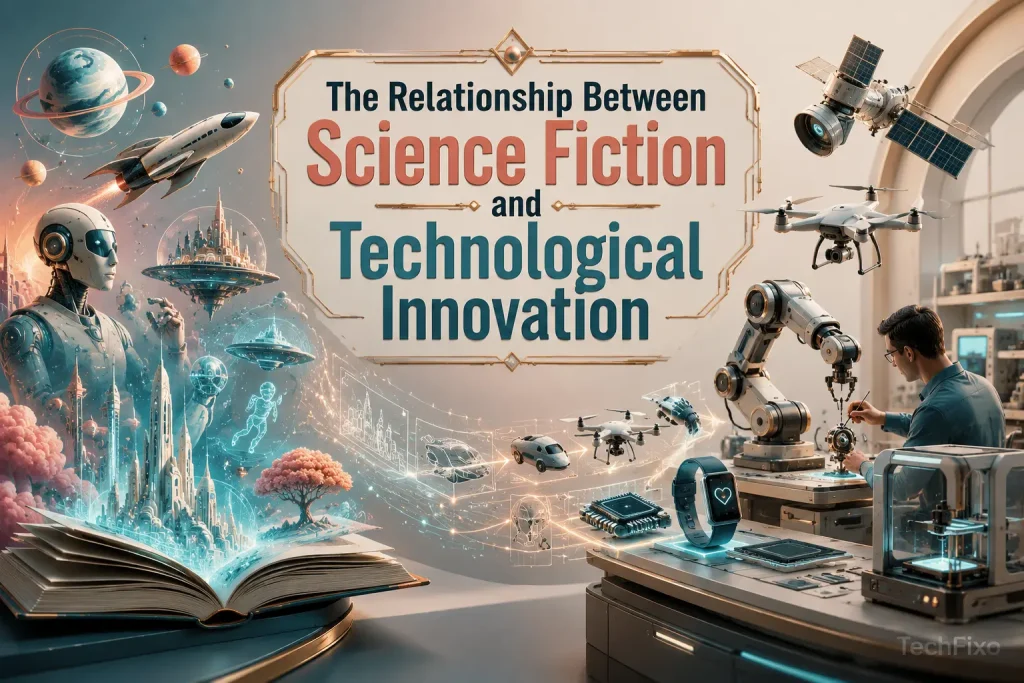
Science fiction creates spaces in which writers and readers can imagine technologies before they exist. It asks what an invention could do, how society might use it and what consequences could follow.
These stories do not function as exact technical plans. Their value comes from exploring possibilities.
Science-fiction technology often begins with a human desire:
- Communicating instantly across distance
- Traveling beyond Earth
- Creating intelligent machines
- Extending human life
- Entering virtual environments
- Automating dangerous work
- Accessing unlimited information
- Overcoming physical limitations
Scientists and engineers then approach similar goals through experimentation, mathematics, materials and design.
This relationship does not mean every fictional technology will become real. It means imagination can help define problems worth solving.
Clarke’s Third Law stands at the meeting point between imagination and engineering. It explains why the successful transformation of an impossible idea into a working system can feel like magic.
Why the Quote Remains Relevant
The quote remains popular because technological development continues to widen the gap between user experience and system complexity.
Earlier machines often exposed their mechanisms. A person could watch gears move, hear an engine operate or observe a mechanical process. Modern digital systems frequently hide their complexity behind screens, voice interfaces and automated services.
As technology becomes easier to use, it may become harder to understand.
This creates an unusual situation: people can control powerful tools without knowing how those tools produce their results.
The quote is particularly relevant to discussions about:
- Artificial intelligence
- Robotics
- Virtual and augmented reality
- Quantum computing
- Space exploration
- Biotechnology
- Brain-computer interfaces
- Automation
- Smart cities
- Human-machine interaction
Each field has the potential to produce capabilities that challenge current expectations.
Future Technologies That May Appear Magical
Future innovations may make today’s advanced devices look simple. Several developing fields could produce experiences that seem almost supernatural to ordinary users.
Brain-Computer Interfaces
Systems that allow communication between neural activity and digital devices could transform how people control machines, interact with software or overcome certain physical limitations.
To an observer, controlling a device without visible movement could resemble telepathy.
Highly Advanced Robotics
Robots may become more capable of navigating unpredictable environments, learning tasks and working alongside humans.
A machine that understands spoken instructions, recognizes surroundings and adapts its behavior could appear remarkably lifelike.
Immersive Digital Environments
Future augmented and virtual reality systems may blend physical and digital experiences more naturally.
Digital objects could appear persistent, responsive and integrated into everyday surroundings, making the boundary between physical and virtual environments less obvious.
Synthetic Biology
Scientists may gain more precise control over biological processes, allowing them to design materials, modify organisms or develop highly personalized treatments.
To someone without knowledge of genetics and cellular biology, such abilities could resemble the transformation stories once found only in mythology.
Quantum Technologies
Quantum systems may solve certain specialized problems, improve sensing or change secure communication. Because quantum behavior differs from everyday physical experience, its applications may be especially difficult for non-specialists to understand.
Advanced Space Technology
New propulsion methods, autonomous spacecraft, robotic exploration and long-term off-world habitats could transform humanity’s relationship with space.
Travel and communication capabilities that currently belong to science fiction may eventually become real engineering achievements.
How to Respond to Technology That Feels Magical
The right response to astonishing technology is neither worship nor fear. It is curiosity supported by critical thinking.
Learn the Basic Mechanism
You do not need expert-level knowledge of every device. A basic understanding of how a technology works can remove unnecessary mystery and help you use it responsibly.
Separate Ability From Marketing
Ask what the technology has actually demonstrated. Do not assume every promised feature is reliable, available or suitable for every situation.
Understand the Limitations
Every technology has boundaries. Knowing where a system fails is often as important as knowing what it can do.
Verify Important Outputs
When technology influences health, money, education, security or legal decisions, important information should be checked through reliable human and professional sources.
Protect Human Judgment
Automation should support human decision-making rather than eliminate responsibility. People remain accountable for how technological tools are designed, deployed and used.
Consider the Ethical Impact
A technology may be impressive while still creating concerns involving privacy, fairness, employment, security or access.
The ability to build something does not automatically prove that every possible use is beneficial.
Frequently Asked Questions
What is the meaning of any sufficiently advanced technology is indistinguishable from magic?
It means that technology can appear supernatural when it is far beyond the observer’s knowledge. The system follows scientific principles, but its complexity makes those principles difficult to recognize.
Who wrote “any sufficiently advanced technology is indistinguishable from magic”?
The statement was written by British science-fiction author and futurist Arthur C. Clarke. It is known as Clarke’s Third Law.
What is Clarke’s Third Law?
Clarke’s Third Law states that any sufficiently advanced technology is indistinguishable from magic. It describes how extraordinary technology may appear supernatural to people who do not understand its mechanisms.
Is advanced technology really magic?
No. Advanced technology operates through physical laws, scientific knowledge and engineering. It only resembles magic when the observer cannot see or understand how it produces a result.
What is an example of technology appearing like magic?
A modern smartphone would likely appear magical to someone from an earlier historical period. It can display moving images, communicate globally, identify locations, store books and respond to spoken commands.
How does the quote relate to artificial intelligence?
AI can produce complex results from simple prompts, making the process appear magical. However, its outputs come from computing systems, algorithms, training data and mathematical models rather than supernatural intelligence.
Does Clarke’s quote suggest that all impossible ideas will become possible?
No. The quote encourages people to remain open-minded about technological progress, but it does not prove that every imagined invention can be created. Scientific evidence and physical limitations still matter.
Why do people call technology magical?
People often use magical language when a technology creates surprising results, operates invisibly or performs tasks they cannot explain. The word expresses wonder rather than describing the true mechanism.
Can understanding technology remove its sense of wonder?
Understanding may remove some mystery, but it does not have to remove wonder. Learning how a technology works can reveal the creativity, experimentation and engineering required to build it.
Why is Clarke’s Third Law important today?
It is important because modern society increasingly depends on complex systems such as AI, algorithms, automated services and global digital networks. The quote reminds people to appreciate innovation while continuing to question, understand and evaluate it.
Conclusion
“Any sufficiently advanced technology is indistinguishable from magic” captures a timeless truth about human perception. When people encounter an invention beyond their knowledge, they judge it by what they can observe. If the cause remains hidden while the effect appears extraordinary, the experience begins to resemble magic.
Arthur C. Clarke’s quote celebrates the power of technological innovation, but it also encourages intellectual responsibility. Wonder should inspire curiosity, not blind trust. Advanced systems should be explored, tested and understood rather than treated as mysterious forces beyond criticism.
Technology may look magical from a distance, yet every genuine invention depends on knowledge, experimentation and human effort. As understanding grows, the mystery fades, the extraordinary becomes familiar and yesterday’s magic becomes part of everyday life.