
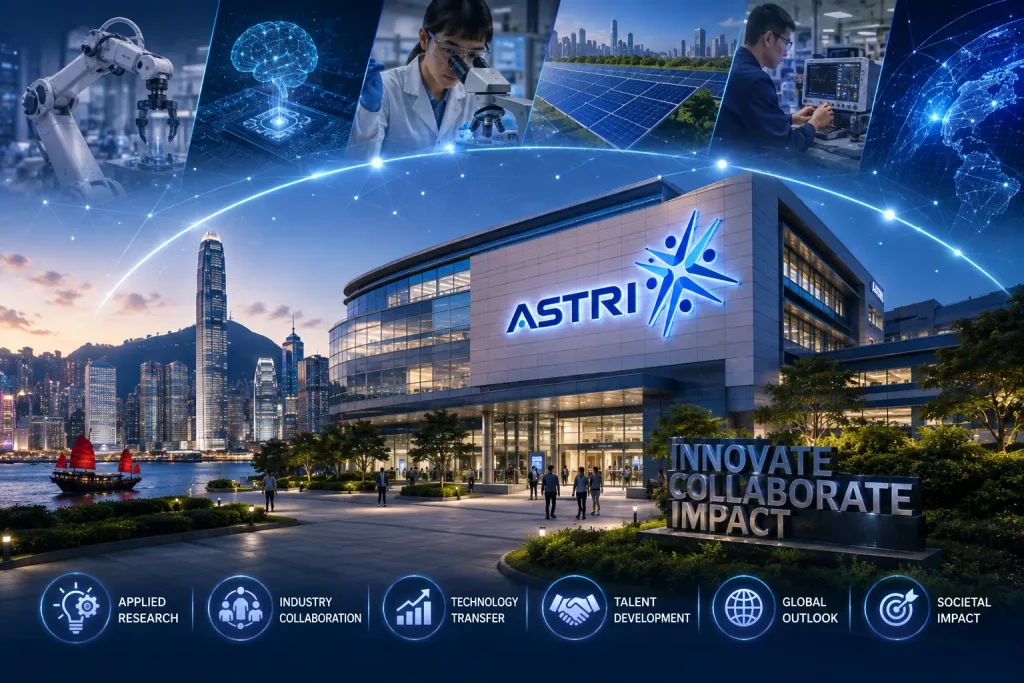
The Hong Kong Applied Science and Technology Research Institute Company Limited, commonly known as ASTRI, is one of the most important organizations in Hong Kong’s innovation and technology ecosystem. It conducts applied research designed to transform scientific knowledge into practical technologies that businesses, public organizations, and communities can use.
ASTRI is not simply a laboratory that studies theoretical ideas. Its work focuses on turning research into commercially viable systems, products, materials, platforms, and industrial solutions. This practical approach allows the institute to connect government development priorities, academic knowledge, industry needs, technology investment, and real-world applications.
Founded by the Government of the Hong Kong Special Administrative Region in 2000, ASTRI was created to strengthen Hong Kong’s competitiveness through applied research. Following its strategic merger with the Nano and Advanced Materials Institute in 2026, its capabilities now extend across information and communications technology, artificial intelligence, electronics, advanced materials, energy storage, smart manufacturing, digital health, financial technology, and sustainable development.
What Is the Hong Kong Applied Science and Technology Research Institute Company Limited?
The Hong Kong Applied Science and Technology Research Institute Company Limited is a government-established research and development organization headquartered at Hong Kong Science Park in Shatin.
Although its full legal name includes the words “Company Limited,” ASTRI is not a conventional commercial technology company focused mainly on selling consumer products. It operates as an applied research institution that develops technologies with potential economic, industrial, and social value.
Its central purpose is to move promising ideas from research environments into practical use. This process is often described as taking innovation from the laboratory to the market.
ASTRI works with:
- Government departments
- Technology companies
- Financial institutions
- Manufacturers
- Universities
- Research organizations
- Healthcare providers
- Infrastructure operators
- Startups
- Investors
- Public service organizations
Through these partnerships, technologies can be tested, improved, licensed, transferred, commercialized, or deployed in real operating environments.
What Does ASTRI Stand For?
ASTRI stands for the Hong Kong Applied Science and Technology Research Institute.
The abbreviation reflects the institute’s emphasis on applied science. Applied research differs from purely theoretical research because it begins with a practical need or identifies how scientific knowledge can solve a real problem.
Examples may include:
- Improving traffic safety with connected vehicle technology
- Using artificial intelligence to analyze financial documents
- Developing secure communication systems
- Creating advanced materials for construction
- Designing more efficient energy-storage technologies
- Improving industrial production with sensors and automation
- Supporting digital healthcare with intelligent diagnostic systems
The value of this research is measured not only through academic knowledge but also through adoption, commercialization, operational improvement, and benefits to society.
History of ASTRI
ASTRI was established in 2000 by the Hong Kong SAR Government. Its original mission was to improve Hong Kong’s economic competitiveness by supporting applied research and the development of commercially relevant technologies.
In 2006, it was designated as Hong Kong’s research and development centre for information and communications technologies. This positioned the institute as a major contributor to areas such as wireless communications, integrated circuits, cybersecurity, artificial intelligence, financial technology, smart city systems, and digital platforms.
Over time, ASTRI expanded its cooperation with businesses, universities, government departments, technology parks, and research institutions. It also strengthened its connections with innovation centers in Mainland China, particularly within the Guangdong-Hong Kong-Macao Greater Bay Area.
A major change occurred on April 1, 2026, when ASTRI completed its strategic merger with the Nano and Advanced Materials Institute. The merger combined ASTRI’s information and communications technology expertise with NAMI’s experience in nanotechnology and advanced materials.
The combined organization became Hong Kong’s largest government-funded research and development centre, bringing together approximately 800 research professionals.
Why ASTRI and NAMI Merged
Before the merger, ASTRI primarily concentrated on information and communications technologies, while NAMI specialized in nanotechnology and advanced materials.
Modern technological challenges often require both digital and physical innovation. A smart electric vehicle, for example, may require artificial intelligence, communication systems, sensors, semiconductor components, advanced battery materials, lightweight structures, and cybersecurity.
Keeping these areas in separate research organizations could limit coordination. The merger created a broader platform where digital technologies and material sciences could be developed together.
The integration was intended to:
- Combine complementary research expertise
- Improve coordination between technology teams
- Support higher-value applied research
- Accelerate technology commercialization
- Strengthen support for new industrialization
- Reduce duplication in administration
- Build more complete end-to-end solutions
- Improve Hong Kong’s international research competitiveness
Following the merger, ASTRI reported a combined portfolio of more than 1,500 patented technologies and over 2,200 technologies transferred to industry.
How Applied Research Works at ASTRI
Applied research typically begins with an identifiable problem, industrial need, commercial opportunity, or public policy objective.
ASTRI researchers may work with an industry partner to understand the problem and determine whether a new technological solution is required.
The process may involve:
- Identifying the problem or market need
- Studying existing technologies
- Developing a research proposal
- Designing an experimental solution
- Building a prototype
- Testing performance and safety
- Conducting trials in realistic environments
- Improving the technology
- Protecting intellectual property
- Transferring or licensing the technology
- Supporting implementation or commercialization
This model reduces the distance between research and practical adoption. Businesses gain access to specialized expertise and research facilities, while researchers gain direct knowledge of operational requirements.
ASTRI’s Technology Divisions
ASTRI’s expanded research structure combines information and communications technology with materials science.
Its research capabilities are organized across technology divisions covering areas such as:
AI Platforms and Solutions
Artificial intelligence research involves creating systems that can analyze information, identify patterns, automate decisions, recognize images, understand language, and assist human users.
Potential applications include:
- Document analysis
- Computer vision
- Predictive maintenance
- Intelligent customer service
- Fraud detection
- Medical image analysis
- Industrial quality inspection
- Smart mobility
- Automated risk assessment
- Generative and agent-based AI applications
ASTRI also explores trustworthy AI, which focuses on security, reliability, privacy, transparency, and responsible use.
Communications Technologies
Communications research supports faster, more reliable, and more secure digital connectivity.
Areas may include:
- 5G and future communication networks
- Private wireless networks
- Cellular vehicle-to-everything technology
- Internet of Things connectivity
- Low-power communication systems
- Network optimization
- Satellite and non-terrestrial communications
- Connected infrastructure
- Smart mobility networks
These technologies are essential for smart cities, automated transport, industrial systems, logistics, emergency services, and digital public infrastructure.
Advanced Electronic Components and Systems
Electronic components are fundamental to modern equipment, including communication devices, vehicles, medical instruments, industrial machinery, sensors, and consumer electronics.
Research in this area may cover:
- Integrated circuits
- Semiconductor-related technologies
- Advanced electronic systems
- Display technologies
- Power electronics
- Sensor systems
- Hardware acceleration
- Application-specific integrated circuits
- Electronic packaging
- Energy-efficient computing
ASTRI’s work in application-specific integrated circuits supports the creation of chips designed for particular tasks rather than general-purpose computing.
Intelligent Sensing and Control
Intelligent sensing systems collect information from physical environments and use that data to guide decisions or control equipment.
Applications may include:
- Industrial automation
- Robotics
- Autonomous systems
- Environmental monitoring
- Smart buildings
- Traffic management
- Construction-site safety
- Healthcare monitoring
- Equipment inspection
- Positioning and navigation
Combining sensors with artificial intelligence allows machines and systems to understand changing conditions and respond more effectively.
Electronic and Battery Materials
Advanced electronic and battery materials can improve performance, durability, energy efficiency, charging speed, safety, and product lifespan.
Research may support:
- Energy storage
- Electric mobility
- Portable electronics
- Grid systems
- Renewable energy
- Industrial power solutions
- Advanced batteries
- Conductive materials
- Thermal management
- Electronic manufacturing
Battery research is particularly important as governments and businesses seek cleaner transportation and more reliable renewable-energy storage.
Construction Materials
Advanced construction materials can help buildings and infrastructure become stronger, lighter, safer, more sustainable, and easier to assemble.
Potential applications include:
- Lightweight concrete
- High-strength materials
- Modular construction
- Sound insulation
- Low-carbon building materials
- Recycled construction materials
- Smart structural components
- Protective barriers
- Durable coatings
These technologies can support construction productivity while reducing waste and environmental impact.
Biomaterials
Biomaterials are designed to interact with biological systems and may be used in healthcare, medical devices, diagnostics, protective products, and life-science applications.
Research can include:
- Medical coatings
- Diagnostic materials
- Biocompatible materials
- Healthcare sensors
- Hygiene technologies
- Drug-delivery materials
- Antimicrobial surfaces
This field combines material science, biology, engineering, and healthcare research.
Functional Polymers
Functional polymers are specially designed materials that provide properties beyond those of ordinary plastics.
They may offer:
- Electrical conductivity
- Heat resistance
- Flexibility
- Chemical resistance
- Light weight
- Optical functions
- Protective properties
- Environmental performance
Functional polymers can be used in electronics, vehicles, medical products, energy systems, construction, packaging, and industrial manufacturing.
ASTRI’s Seven Core Application Areas
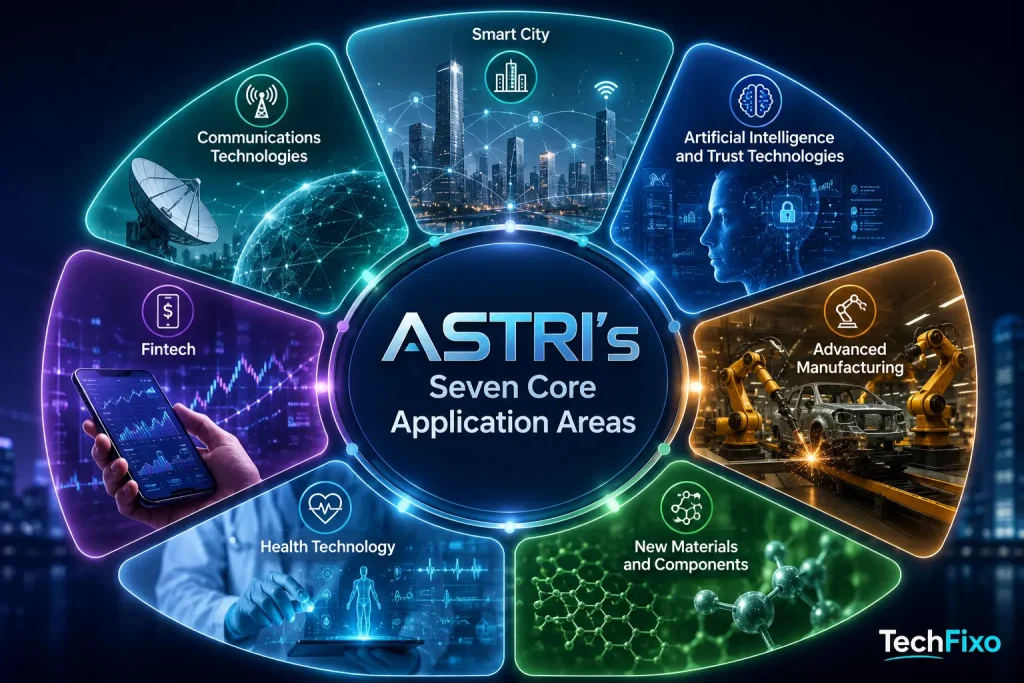
ASTRI applies its research capabilities across seven major areas.
| Application Area | Main Technology Focus | Potential Benefits |
|---|---|---|
| Smart City | Connectivity, mobility, sensing, construction and urban systems | Safer transport, efficient infrastructure and improved public services |
| Financial Technology | AI, cybersecurity, blockchain and data analytics | Faster services, better risk management and stronger financial security |
| Digital Health and Life Sciences | Medical AI, sensing, biomaterials and health platforms | Improved diagnostics, monitoring and healthcare delivery |
| New Industrialisation | Robotics, automation, inspection and intelligent manufacturing | Higher productivity, better quality and more flexible production |
| ASIC and Advanced Electronics | Integrated circuits, components and electronic systems | Specialized hardware and improved electronic performance |
| New Energy and Energy Storage | Batteries, energy materials and power technologies | Cleaner energy use, improved storage and greater efficiency |
| Green and ESG Technologies | Sustainable materials, energy management and environmental solutions | Lower emissions, reduced waste and stronger sustainability performance |
Smart City Research
Smart city development uses technology to improve urban services, mobility, safety, infrastructure, sustainability, and quality of life.
ASTRI’s smart city research combines artificial intelligence, communications, sensing technologies, advanced electronics, and materials.
Its work may support:
- Connected vehicles
- Traffic management
- Electronic road systems
- Smart construction sites
- Geographic information systems
- Public safety technologies
- Smart buildings
- Infrastructure monitoring
- Internet of Things platforms
- Augmented and virtual reality
- Energy-efficient devices
- Low-carbon construction materials
One important field is cellular vehicle-to-everything technology, commonly known as C-V2X. It enables vehicles to exchange information with other vehicles, traffic infrastructure, pedestrians, and communication networks.
This exchange can provide warnings about hazards, road conditions, traffic signals, and nearby vehicles. The objective is to improve road safety and traffic efficiency.
ASTRI’s official smart city portfolio also includes private 5G networks for construction sites, positioning systems for modular construction, smart road-safety equipment, connected mobility, and sustainable construction materials.
Financial Technology Research
Hong Kong is an international financial centre, making financial technology an important area for applied research.
ASTRI develops technologies that may help financial institutions improve efficiency, regulatory compliance, customer service, data protection, and risk assessment.
Research areas include:
- Artificial intelligence
- Big data analytics
- Federated learning
- Document processing
- Optical character recognition
- Cybersecurity
- Blockchain
- Digital identity
- Fraud detection
- Regulatory technology
- Automated financial analysis
- Intelligent chatbots
Federated learning is particularly relevant to financial services because it can allow organizations to train shared analytical models without directly combining all sensitive data in one location.
ASTRI’s FinTech research also includes semantic document matching, AI-assisted insurance applications, privacy-aware analytics, blockchain systems, and automated cybersecurity analysis.
Digital Health and Life Sciences
Digital health combines medical knowledge with technologies such as artificial intelligence, sensors, communication platforms, imaging systems, advanced materials, and data analytics.
ASTRI’s expanded capabilities can support:
- Medical image analysis
- Remote health monitoring
- Intelligent diagnostic assistance
- Wearable sensors
- Healthcare data platforms
- Biomaterials
- Medical-device technologies
- Laboratory automation
- Elderly-care solutions
- Hospital operations
- Life-science research
Digital health technology is not intended to remove medical professionals from decision-making. Its value lies in helping professionals examine information, monitor conditions, improve workflows, and deliver services more efficiently.
Medical applications require careful attention to accuracy, patient privacy, safety, regulatory requirements, and clinical validation.
New Industrialisation and Intelligent Manufacturing
New industrialisation refers to the development of advanced, technology-driven manufacturing systems.
Instead of depending only on manual processes and traditional production lines, intelligent factories use sensors, software, robotics, data analytics, artificial intelligence, and connected machinery.
ASTRI’s research can support manufacturers through:
- Automated visual inspection
- Predictive maintenance
- Production monitoring
- Digital twins
- Industrial robotics
- Smart logistics
- Flexible manufacturing
- Private 5G networks
- Quality-control systems
- Energy management
- Advanced manufacturing materials
These solutions can help manufacturers identify defects, reduce downtime, improve consistency, lower production costs, and respond more quickly to changing demand.
ASIC and Advanced Electronics
An application-specific integrated circuit is a chip designed to perform a particular function.
Unlike a general-purpose processor, an ASIC can be optimized for a specific application, such as image processing, communication, artificial intelligence, sensing, security, or power management.
ASIC development can offer advantages such as:
- Faster processing
- Lower energy consumption
- Smaller device size
- Improved reliability
- Specialized security
- Better hardware performance
Developing advanced electronics capabilities is important for industries that depend on specialized hardware, including communication technology automotive systems, industrial equipment, healthcare devices, and artificial intelligence.
New Energy and Energy Storage
The transition toward cleaner energy requires more than producing electricity from renewable sources. Energy must also be stored, managed, distributed, and used efficiently.
ASTRI’s post-merger energy research can include:
- Battery materials
- Energy-storage systems
- Thermal management
- Battery safety
- Charging technologies
- Power electronics
- Energy-efficient devices
- Renewable-energy integration
- Industrial energy systems
- Electric mobility
Better energy-storage technologies can support electric vehicles, renewable power, portable devices, smart buildings, and electricity networks.
Green and ESG Technologies
Environmental, social, and governance considerations have become important for governments, companies, investors, and communities.
ASTRI’s green technology research can support organizations seeking to reduce emissions, waste, energy consumption, and environmental damage.
Relevant areas include:
- Low-carbon construction materials
- Recycled building materials
- Energy-efficient electronics
- Sustainable manufacturing
- Environmental monitoring
- Green energy storage
- Smart resource management
- Durable advanced materials
- Waste reduction
- Carbon-data analysis
Technology alone cannot guarantee strong ESG performance. However, reliable measurement systems, efficient equipment, sustainable materials, and accurate data can help organizations implement and verify improvements.
How ASTRI Transfers Technology to Industry
Technology transfer is the process of moving research results from a research institute into practical use.
ASTRI may transfer technology through:
- Licensing agreements
- Joint research projects
- Industry partnerships
- Commercialization arrangements
- Prototype testing
- Technical consultancy
- Research contracts
- Startup support
- Intellectual property agreements
- Demonstration projects
A company may license a technology and incorporate it into a commercial product. A public organization may test a system in a real operational environment. A manufacturer may work with researchers to adapt a technology to its production process.
Technology transfer is important because a patent or prototype creates limited value when it remains unused. Real impact occurs when the technology improves a service, supports a business, creates a product, solves an industrial problem, or benefits the public.
ASTRI Compared With Other Research Organizations
| Organization Type | Primary Purpose | Typical Research Output | Relationship With Industry |
|---|---|---|---|
| ASTRI | Applied research and technology commercialization | Prototypes, patents, platforms, materials and transferable technologies | Direct collaboration and technology transfer |
| University | Education and knowledge creation | Academic publications, theories, trained graduates and discoveries | Varies by department and research project |
| Private Technology Company | Commercial growth and customer solutions | Products, services and proprietary systems | Driven by customers, competition and revenue |
| Government Department | Policy development and public administration | Regulations, programs and public services | Procures or supports technologies for public needs |
| Startup | Rapid development of a scalable business | Specialized products or platforms | Seeks customers, investment and market growth |
ASTRI occupies a connecting position between universities, government bodies, established companies, startups, manufacturers, and investors.
It can take early-stage knowledge, develop it into a practical technology, and work with industry partners to support adoption.
ASTRI’s Role in Hong Kong’s Innovation Ecosystem
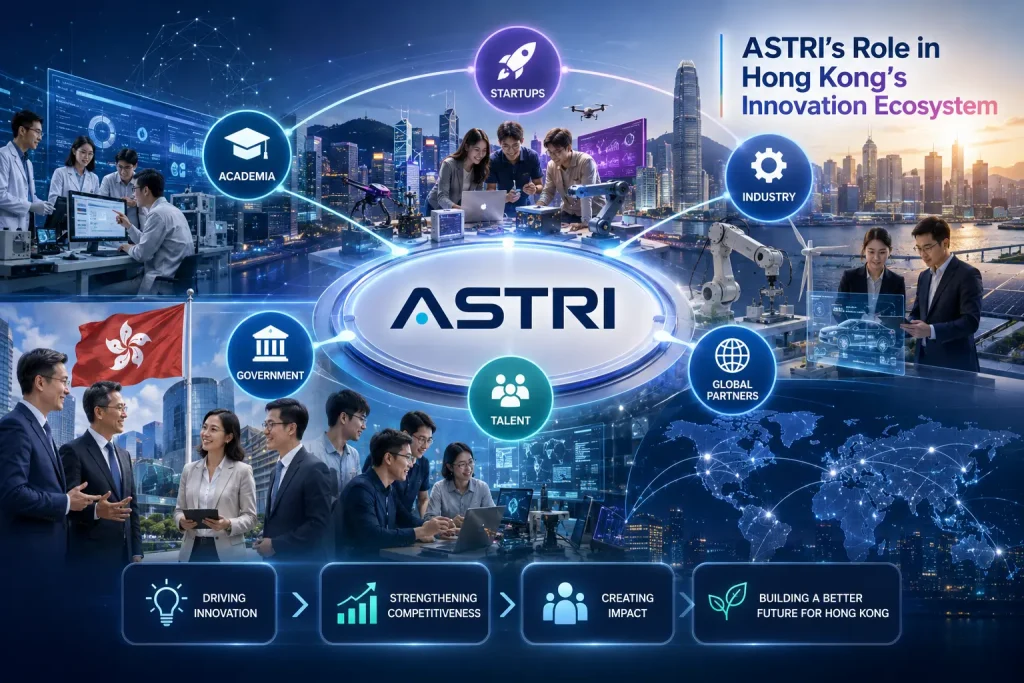
Hong Kong has several advantages as an innovation hub, including international financial connections, research universities, professional services, infrastructure, access to investment, and proximity to major manufacturing and technology centers in Mainland China.
However, successful innovation requires organizations that can connect these advantages.
ASTRI helps connect:
- Scientific research with industry needs
- Hong Kong companies with research expertise
- Local innovation with Greater Bay Area manufacturing
- Government priorities with practical technology
- Startups with intellectual property
- Investors with commercial research opportunities
- Universities with industrial applications
- Overseas partners with Hong Kong’s technology ecosystem
This connector role is important because innovation often fails when research, funding, production, regulation, and market demand remain separated.
Collaboration in the Greater Bay Area
The Guangdong-Hong Kong-Macao Greater Bay Area includes major technology, manufacturing, financial, and research centers.
Hong Kong contributes strengths in research, finance, international business, law, professional services, and intellectual property protection. Cities such as Shenzhen and Dongguan offer large technology and manufacturing ecosystems.
ASTRI can help connect these strengths by supporting:
- Cross-border research cooperation
- Product development
- Prototype manufacturing
- Industrial testing
- Technology licensing
- Joint laboratories
- Talent development
- Commercialization
- International market access
This cooperation can shorten the journey from scientific idea to manufactured product.
Opportunities for Businesses
Companies may work with ASTRI when they need advanced research capabilities but do not have the resources to build a complete internal research department.
Potential benefits include:
- Access to experienced researchers
- Reduced early-stage development risk
- Use of specialized laboratories
- Faster prototype development
- Access to patented technology
- Technical testing and validation
- Opportunities for joint research
- Support for product differentiation
- Connections within the innovation ecosystem
A partnership is most likely to succeed when the company has a clearly defined problem, realistic commercial expectations, internal technical support, and a plan for adopting the research outcome.
Research Careers and Talent Development
Applied research institutes require professionals from many disciplines.
Career areas may include:
- Artificial intelligence
- Data science
- Software engineering
- Telecommunications
- Cybersecurity
- Electronics
- Integrated circuit design
- Mechanical engineering
- Robotics
- Chemistry
- Materials science
- Biomedical engineering
- Battery research
- Product development
- Intellectual property
- Technology commercialization
- Project management
Working in applied research can appeal to professionals who want to solve practical problems while remaining involved in scientific and technological development.
Researchers must often understand both technical performance and industry requirements. A solution may work successfully in a laboratory but still require improvements in cost, durability, safety, usability, scalability, or regulatory compliance.
Benefits of ASTRI’s Research Model
The institute’s applied research model provides several potential advantages.
It Connects Research With Real Problems
Projects can be shaped by challenges faced by businesses, public services, and communities.
It Reduces Commercialization Barriers
Industry partners can access prototypes, patents, research expertise, and testing support.
It Encourages Cross-Disciplinary Innovation
The merger of digital technology and advanced materials capabilities allows researchers to develop more complete solutions.
It Supports Local Technology Development
Hong Kong companies can gain access to research capabilities without depending entirely on imported technologies.
It Develops Innovation Talent
Researchers gain experience in practical projects, while businesses benefit from a larger pool of technically skilled professionals.
It Strengthens Economic Competitiveness
Commercialized technologies can support productivity, new industries, investment, exports, and high-value employment.
Challenges Facing Applied Research Institutes
Applied research organizations also face challenges.
Converting Research Into Commercial Products
A technically successful prototype may not automatically become a profitable product. Commercialization requires investment, manufacturing, marketing, regulatory approval, customer demand, and long-term support.
Balancing Public and Commercial Value
Government-funded research must provide public benefits while also supporting commercially relevant innovation.
Keeping Pace With Rapid Technology Change
Fields such as artificial intelligence, semiconductors, cybersecurity, batteries, and communications develop quickly. Research priorities must be reviewed regularly.
Protecting Data and Intellectual Property
Collaboration requires clear agreements regarding confidential information, patents, ownership, licensing, and commercial rights.
Attracting Research Talent
Hong Kong competes internationally for engineers, scientists, data specialists, and technology leaders.
Measuring Long-Term Impact
Patent counts and technology transfers are useful measures, but the full value of research may also include business growth, productivity, public safety, environmental improvements, and talent development.
Frequently Asked Questions
What is the Hong Kong Applied Science and Technology Research Institute Company Limited?
It is a government-established applied research and development organization commonly known as ASTRI. It develops practical technologies and works with industry, government, academic institutions, and other partners to support commercialization and innovation.
What does ASTRI stand for?
ASTRI stands for the Hong Kong Applied Science and Technology Research Institute.
When was ASTRI established?
ASTRI was established by the Hong Kong SAR Government in 2000.
Is ASTRI a government organization?
ASTRI is a government-established and government-funded research and development centre. It operates as an applied research institution rather than an ordinary government department.
Where is ASTRI located?
Its main office is located at the Photonics Centre in Hong Kong Science Park, Shatin, Hong Kong.
What type of research does ASTRI conduct?
It conducts applied research in artificial intelligence, communications, electronics, intelligent sensing, smart cities, financial technology, digital health, manufacturing, advanced materials, energy storage, integrated circuits, and sustainable technologies.
What happened to NAMI?
The Nano and Advanced Materials Institute completed a strategic merger with ASTRI on April 1, 2026. Its advanced-materials capabilities were integrated into the expanded ASTRI research platform.
Why was the ASTRI and NAMI merger important?
The merger combined information and communications technology with nanotechnology and materials science. This allows the organization to develop more complete solutions involving software, hardware, electronics, energy, and advanced materials.
Does ASTRI sell products?
ASTRI primarily develops and transfers technologies rather than operating like a conventional consumer-products company. Technologies may be licensed, commercialized, tested, or implemented with industry partners.
How can businesses work with ASTRI?
Businesses may participate in joint research, technology licensing, contract projects, prototype development, testing, consultancy, commercialization, or other forms of collaboration.
Does ASTRI work only in Hong Kong?
Its main role is to support Hong Kong’s innovation and technology development, but it also collaborates with organizations in Mainland China and international innovation ecosystems.
What is technology transfer?
Technology transfer is the process of moving research results, patents, prototypes, or technical knowledge from a research organization into commercial or operational use.
Why is applied research important?
Applied research helps turn scientific knowledge into technologies that solve practical problems, improve productivity, create business opportunities, and deliver public benefits.
Conclusion
The Hong Kong Applied Science and Technology Research Institute Company Limited occupies a distinctive position in Hong Kong’s technology landscape. It is neither a traditional university nor a conventional commercial technology company. Its central role is to connect scientific knowledge with the practical requirements of industry and society.
Since its establishment in 2000, ASTRI has contributed to Hong Kong’s development in communications, financial technology, artificial intelligence, smart city systems, integrated circuits, intelligent manufacturing, and digital health.
Its 2026 merger with the Nano and Advanced Materials Institute significantly expanded that role. By bringing information technology, electronics, advanced materials, batteries, energy, construction technologies, and sustainability research into one organization, ASTRI can address problems that cannot be solved by software or material science alone.
The institute’s future importance will depend not only on how many technologies it patents but also on how effectively those technologies move into factories, hospitals, financial services, transport systems, buildings, energy networks, and public infrastructure.
When research produces safer roads, more efficient manufacturing, improved healthcare, secure financial systems, sustainable materials, and stronger businesses, applied science becomes more than an academic activity. It becomes a practical contributor to economic competitiveness and everyday life.