
Social media has become an important connection point between businesses and their customers. People use social platforms to discover brands, compare products, watch demonstrations, read comments, ask questions and decide whether a company appears trustworthy.
However, creating a few accounts and publishing occasional posts is not a complete marketing strategy. Businesses need relevant content, consistent branding, audience research, community engagement, advertising, performance tracking and a clear process for converting attention into measurable results.
The keyword social media Appkod is commonly associated with Appkod’s social media marketing and management services. These services are intended to help businesses improve online visibility, communicate with their target audience and use platforms such as Facebook, Instagram, LinkedIn and YouTube more strategically.
A successful social media campaign should produce more than likes and followers. It should support meaningful outcomes such as enquiries, website visits, bookings, product sales, customer retention and stronger brand recognition.
What Does Social Media Appkod Mean?
Social media Appkod refers to the social media marketing solutions, strategies and information associated with Appkod.
Appkod presents social media as part of a broader digital marketing service offering. Its social media service page discusses marketing across Facebook, Instagram, LinkedIn, YouTube and other major platforms. It also focuses on content creation, audience engagement, campaign management, lead generation and brand awareness.
These services may help a business with:
- Social media strategy
- Account management
- Content planning
- Graphic creation
- Video marketing
- Caption writing
- Audience research
- Paid social advertising
- Community management
- Campaign optimization
- Lead generation
- Performance reporting
The exact service mix should depend on the company’s industry, audience, objectives, available content and marketing budget.
A business-to-business company may require a LinkedIn-focused strategy, while an online fashion store may benefit more from Instagram, Facebook and short-form video content.
Why Social Media Marketing Matters
Social media gives businesses an opportunity to communicate with customers in places where they already spend time.
Unlike a static advertisement, social platforms allow two-way communication. Customers can respond, ask questions, share opinions, review products and interact directly with a company.
It Builds Brand Awareness
Customers are more likely to remember a business they see consistently.
Social media can help a company repeatedly present its:
- Brand name
- Visual identity
- Products
- Services
- Expertise
- Customer results
- Values
- Offers
- Team members
- Business personality
Consistent visibility can make the company more familiar when a customer is ready to make a purchase.
Brand awareness does not always generate immediate sales. Its value often appears later when a customer recognizes the company during a search or comparison.
It Creates Direct Customer Communication
Social platforms allow customers to contact businesses through comments, direct messages and replies.
They may ask about:
- Prices
- Product availability
- Service areas
- Delivery times
- Booking options
- Product features
- Business hours
- Returns
- Technical support
A prompt and professional response can improve trust. An ignored question may push the customer toward a competitor.
It Supports Website Traffic
Social content can direct users to:
- Service pages
- Product pages
- Blog articles
- Landing pages
- Booking forms
- Contact pages
- Special offers
- Event registrations
The linked page should match the promise made in the post or advertisement. Sending every visitor to the homepage can create unnecessary confusion.
It Helps Generate Leads
Lead generation involves attracting people who may become customers and encouraging them to provide contact information or make an enquiry.
Social media lead-generation methods include:
- Direct-message campaigns
- Contact forms
- Downloadable resources
- Webinar registrations
- Consultation offers
- Quote requests
- Product demonstrations
- Limited-time promotions
- Lead advertisements
The number of leads is not the only measure of success. Businesses should also track lead quality and how many enquiries become paying customers.
It Strengthens Customer Relationships
Social media can support communication after a customer has made a purchase.
Businesses can use it to:
- Share support information
- Answer common questions
- Announce updates
- Request feedback
- highlight customer experiences
- Introduce related products
- Promote loyalty offers
- Resolve concerns
A customer who feels heard and supported may be more likely to return or recommend the company.
It Provides Useful Market Insights
Comments, messages, reviews and content performance can reveal what customers care about.
Businesses may discover:
- Frequently asked questions
- Common objections
- Product preferences
- Customer frustrations
- Popular content formats
- Emerging topics
- Competitor weaknesses
- Language customers naturally use
These insights can improve products, website content, advertising and customer service.
Social Media Appkod Services
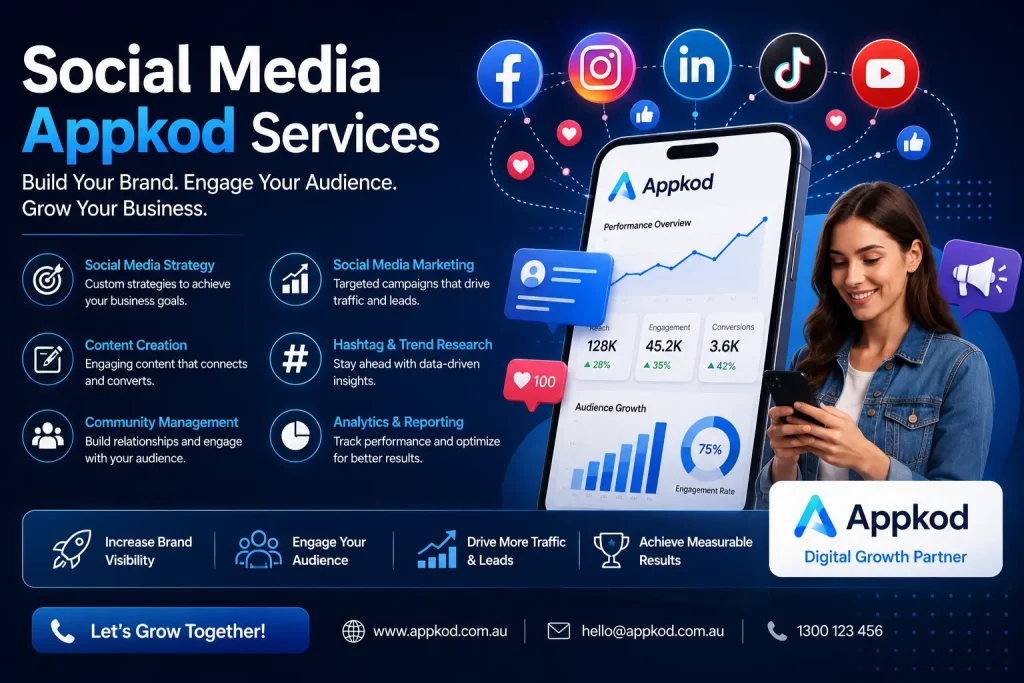
A structured social media service should cover planning, production, publishing, interaction, advertising and reporting.
Social Media Strategy
A social media strategy defines what a business wants to achieve and how it will use each platform.
It should identify:
- Target audience
- Business objectives
- Priority platforms
- Brand voice
- Content categories
- Posting frequency
- Advertising budget
- Performance indicators
- Approval process
- Community management rules
Without a strategy, businesses may publish content regularly without knowing whether it supports a useful outcome.
Setting Clear Objectives
Social media goals should connect with wider business priorities.
Common objectives include:
- Increasing brand awareness
- Generating enquiries
- Driving website traffic
- Selling products
- Growing an email list
- Building a community
- Recruiting employees
- Improving customer support
- Promoting an event
- Launching a new service
A campaign should not attempt to achieve every objective at the same time. Selecting one or two primary outcomes creates a clearer strategy.
Social Media Account Management
Social media management involves maintaining a company’s profiles and coordinating regular activity.
This may include:
- Updating profile information
- Creating a content calendar
- Scheduling posts
- Publishing content
- Responding to comments
- Monitoring messages
- Checking mentions
- Managing approvals
- Tracking performance
- Reporting results
Professional account management creates consistency and reduces the risk of abandoned profiles, unanswered messages and conflicting brand communication.
Profile Optimization
A social media profile should clearly communicate:
- Who the business is
- What it offers
- Who it serves
- Where it operates
- How customers can make contact
- What action visitors should take next
Profile images, cover images, descriptions, contact details and links should be accurate and consistent.
Content Creation
Content gives people a reason to follow, remember and interact with a brand.
Social media content may include:
- Static graphics
- Photographs
- Short videos
- Carousels
- Stories
- Polls
- Live broadcasts
- Customer testimonials
- Product demonstrations
- Educational posts
- Behind-the-scenes content
- Case studies
- Industry updates
Good content should be useful, relevant and easy to understand. It should not be a constant stream of direct sales messages.
Content Pillars
Content pillars are the main subjects a business discusses repeatedly.
A digital marketing agency might use pillars such as:
- SEO education
- Social media tips
- Paid advertising
- Client results
- Website improvement
- Industry news
A fitness business might use:
- Exercise guidance
- Nutrition education
- Member progress
- Trainer introductions
- Class information
- Motivation
Content pillars help maintain variety without making the account feel random.
Educational Content
Educational content answers questions and explains useful ideas.
Examples include:
- How-to posts
- Common mistakes
- Short tutorials
- Checklists
- Definitions
- Frequently asked questions
- Industry myths
- Product-care guidance
This content can demonstrate expertise before asking the audience to make a purchase.
Promotional Content
Promotional content introduces products, services and offers.
It may include:
- Product benefits
- New-service announcements
- Discounts
- Limited-time packages
- Event promotions
- Booking availability
- Product launches
Promotional posts should explain why the offer matters rather than simply telling people to buy.
Trust-Building Content
Customers often look for evidence before choosing a business.
Trust-building content can include:
- Customer reviews
- Case studies
- Before-and-after examples
- Certifications
- Team profiles
- Work processes
- Behind-the-scenes footage
- Frequently asked questions
- Honest product demonstrations
Claims should be accurate and supportable. Businesses should not publish fabricated reviews or misleading results.
Facebook Marketing Appkod
Facebook can support local businesses, online stores, service providers, community organizations and consumer brands.
A Facebook strategy may include:
- Business-page optimization
- Organic content
- Community engagement
- Facebook advertising
- Lead-generation forms
- Retargeting
- Video content
- Event promotion
- Messenger communication
Facebook Organic Content
Organic Facebook content can help businesses communicate with existing followers and local communities.
Suitable content may include:
- Company updates
- Customer stories
- Helpful advice
- New products
- Local events
- Team introductions
- Questions and polls
- Video demonstrations
Organic reach may vary, so businesses should focus on producing valuable content rather than expecting every post to reach the entire audience.
Facebook Advertising
Facebook advertising allows marketers to target audiences based on characteristics such as location, demographics, interests and previous interactions.
Campaign goals may include:
- Website visits
- Video views
- Product sales
- Form submissions
- Messages
- Event responses
- Brand awareness
Paid campaigns should use clear offers, relevant creative material and accurately configured tracking.
Instagram Marketing Appkod
Instagram is highly visual and can work well for brands with products, transformations, experiences, people or processes that can be shown through images and video.
Instagram content formats include:
- Feed posts
- Reels
- Stories
- Carousels
- Live video
- Product content
- Direct messages
Instagram Reels
Reels can help businesses communicate quickly through short videos.
Useful Reel ideas include:
- Demonstrations
- Quick tips
- Before-and-after results
- Behind-the-scenes clips
- Product uses
- Common mistakes
- Customer questions
- Day-in-the-life content
The first few seconds should clearly establish the topic. Long introductions may cause viewers to leave.
Instagram Stories
Stories can be used for more immediate and informal communication.
Businesses may share:
- Daily updates
- Polls
- Questions
- Limited-time offers
- New posts
- Customer feedback
- Work in progress
- Event reminders
Stories can encourage interaction without permanently filling the main profile feed.
Instagram Carousels
Carousels allow multiple images or slides in one post.
They are suitable for:
- Step-by-step guidance
- Educational lists
- Product comparisons
- Case studies
- Common mistakes
- Frequently asked questions
- Before-and-after examples
Each slide should be easy to read and logically connected to the next.
LinkedIn Marketing Appkod
LinkedIn is particularly useful for business-to-business companies, consultants, recruiters, agencies, technology firms and professional service providers.
A LinkedIn strategy may focus on:
- Professional expertise
- Industry commentary
- Company news
- Case studies
- Employee insights
- Recruitment
- Lead generation
- Business networking
Company Page Marketing
A complete LinkedIn company page should include accurate service information, branding, location details and a clear description.
Content may include:
- Industry analysis
- Client results
- Company achievements
- Research findings
- Team expertise
- Event participation
- Business advice
- Product updates
Personal Branding
Business leaders and employees may generate stronger engagement through personal profiles than through a company page alone.
Personal-brand content can include:
- Professional lessons
- Opinions on industry changes
- Project experiences
- Practical advice
- Career stories
- Business challenges
- Leadership insights
It should sound human and credible rather than like a copied company advertisement.
LinkedIn Lead Generation
LinkedIn campaigns can target audiences according to professional characteristics such as role, industry, organization and seniority.
This can help businesses promote:
- Consultations
- Demonstrations
- Reports
- Webinars
- Business services
- Software
- Recruitment opportunities
Because business-to-business sales cycles can be long, LinkedIn campaigns may need follow-up content and lead nurturing.
YouTube Marketing Appkod
YouTube allows businesses to publish longer educational, promotional and demonstration-based videos.
Suitable YouTube content includes:
- Tutorials
- Product reviews
- Service explanations
- Interviews
- Case studies
- Webinars
- Comparisons
- Frequently asked questions
- Customer stories
YouTube content can continue attracting views after publication when titles, descriptions, thumbnails and topics match what users search for.
YouTube Shorts
Shorts can be used for quick tips, demonstrations, highlights and answers.
They may help a business reach viewers who prefer fast content, while longer videos can provide deeper explanations.
Video Search Optimization
Video optimization may include:
- Keyword-focused titles
- Clear descriptions
- Accurate captions
- Relevant thumbnails
- Chapters
- Playlists
- Calls to action
The video should satisfy the promise made by its title and thumbnail.
TikTok Marketing
TikTok can support brands that can produce frequent, short and engaging video content.
It may be suitable for:
- Consumer products
- Food businesses
- Fashion
- Beauty
- Entertainment
- Education
- Fitness
- Travel
- Personal brands
- Local services with visual work
Successful TikTok content often feels natural to the platform rather than resembling a traditional advertisement.
Businesses should not copy every trend. Trends should only be used when they fit the audience and brand identity.
Organic Social Media vs Paid Social Advertising
Organic and paid social media serve different purposes.
| Area | Organic Social Media | Paid Social Advertising |
|---|---|---|
| Cost | Requires content and management resources | Requires content, management and advertising budget |
| Reach | Depends on followers and platform distribution | Can reach selected audiences beyond existing followers |
| Speed | Usually develops gradually | Can generate visibility quickly |
| Targeting | Limited targeting control | Detailed audience targeting options |
| Main Strength | Community, trust and ongoing communication | Reach, traffic, leads and sales |
| Content Lifespan | Can continue receiving engagement | Usually stops when the campaign budget ends |
| Testing | Slower because reach may be limited | Allows structured testing of audiences and creative material |
| Best Use | Long-term brand presence | Accelerated campaign results |
The strongest approach often combines both.
Organic content builds credibility and gives visitors useful material to review. Paid advertising expands reach and directs selected audiences toward specific actions.
Social Media Management Process
A professional process makes social media activity more organized and measurable.
Business and Audience Discovery
The first stage should examine:
- Products and services
- Target customers
- Geographic market
- Competitors
- Brand personality
- Existing accounts
- Previous results
- Customer questions
- Sales process
- Available content resources
A strategy should reflect the business rather than use the same template for every client.
Social Media Audit
An audit reviews existing profiles and performance.
It may identify:
- Incomplete profile information
- Inconsistent branding
- Irregular posting
- Weak content formats
- Unanswered comments
- Low engagement
- Poor targeting
- Missing tracking
- Outdated links
- Competitor opportunities
The audit helps determine what should be improved, continued or removed.
Platform Selection
A business should choose platforms according to audience behaviour and commercial relevance.
Questions to consider include:
- Where does the target audience spend time?
- Which formats can the business produce well?
- Is the objective business-to-business or consumer-focused?
- Does the product require visual demonstration?
- Can the company respond to messages regularly?
- Is there a budget for paid distribution?
It is often better to manage two platforms properly than maintain six inactive accounts.
Content Calendar
A content calendar organizes upcoming posts.
It may include:
- Publication date
- Platform
- Content topic
- Format
- Caption
- Creative requirements
- Call to action
- Approval status
- Campaign objective
Planning content in advance creates consistency while leaving space for timely updates.
Content Production
The production process may involve:
- Research
- Copywriting
- Photography
- Graphic design
- Video recording
- Editing
- Caption creation
- Approval
- Scheduling
Content should be reviewed for accuracy, branding, spelling and legal concerns before publication.
Publishing and Engagement
After content is published, the account should be monitored for:
- Questions
- Comments
- Direct messages
- Mentions
- Complaints
- Opportunities for conversation
Community management should use a clear response style and escalation process.
Analysis and Improvement
Performance data should be reviewed regularly.
The business can then identify:
- Best-performing topics
- Strongest formats
- Effective posting times
- High-converting advertisements
- Weak audience segments
- Frequently asked questions
- New content opportunities
The strategy should evolve according to evidence rather than assumptions.
Social Media Advertising Strategy
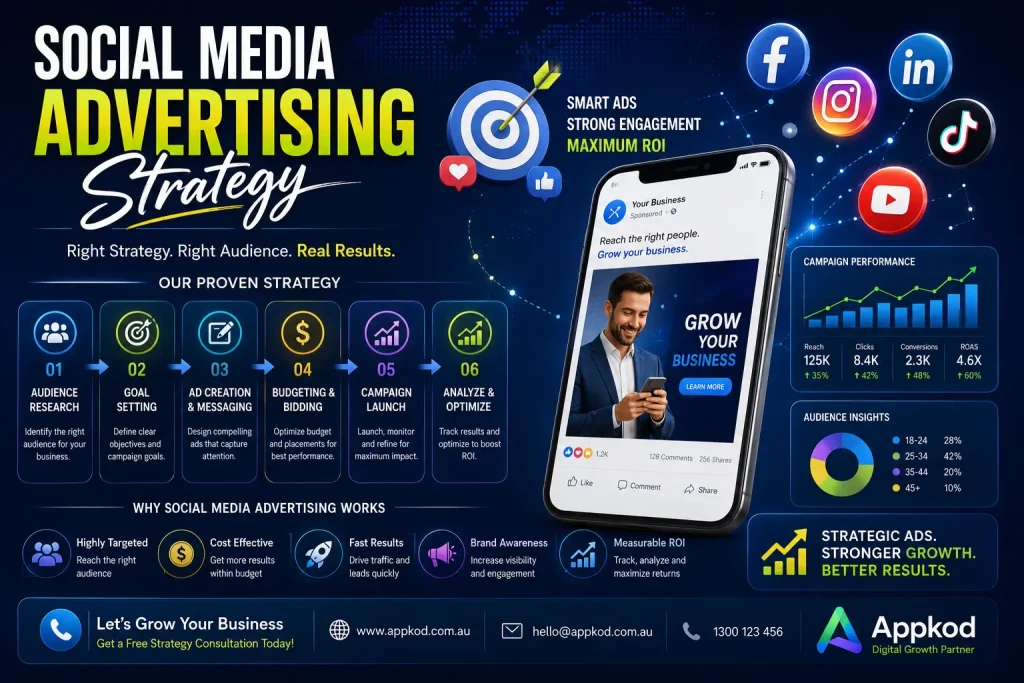
Paid campaigns require more than selecting a post and increasing its reach.
Define the Campaign Goal
Every campaign should have one main objective, such as:
- Awareness
- Video views
- Website visits
- Messages
- Leads
- App installations
- Product sales
- Event registrations
The chosen objective influences how the platform distributes the advertisement.
Build the Right Audience
Targeting may include:
- Location
- Age range
- Interests
- Professional role
- Customer lists
- Website visitors
- Previous engagement
- Similar audiences
Targeting should be relevant without becoming unnecessarily narrow.
Create Strong Advertisements
An effective social advertisement usually contains:
- A clear opening
- A recognizable problem or desire
- A specific benefit
- Relevant visual content
- A credible offer
- A direct call to action
Different versions should be tested rather than assuming the first advertisement will perform best.
Improve the Landing Page
The landing page should continue the same message shown in the advertisement.
It should provide:
- A matching headline
- Clear benefits
- Supporting evidence
- A simple form or purchase process
- Mobile-friendly design
- Fast loading
- A visible call to action
Strong advertising cannot fully overcome a poor landing page.
Social Media Content Ideas for Businesses
Businesses often struggle because they do not know what to publish.
Useful ideas include:
- Answer a customer question
- Explain a common mistake
- Show a product in use
- Introduce a team member
- Share a customer result
- Explain the service process
- Compare two options
- Correct an industry myth
- Show behind-the-scenes work
- Share a useful checklist
- Highlight a product feature
- Discuss a current industry issue
- Present a short case study
- Ask the audience a question
- Demonstrate expertise through a tutorial
One core idea can be adapted into several formats. A detailed article may become a LinkedIn post, carousel, short video, story and email topic.
Measuring Social Media Performance
Social media should be measured according to the campaign objective.
Awareness Metrics
Awareness metrics include:
- Reach
- Impressions
- Video views
- Profile visits
- Follower growth
- Brand mentions
These numbers show visibility but do not necessarily indicate sales.
Engagement Metrics
Engagement may include:
- Comments
- Shares
- Saves
- Reactions
- Replies
- Link clicks
- Direct messages
Shares and saves may indicate stronger interest than a simple reaction.
Lead and Sales Metrics
Commercial metrics include:
- Enquiries
- Lead-form submissions
- Bookings
- Purchases
- Cost per lead
- Cost per sale
- Conversion rate
- Revenue
- Return on advertising spend
These measures help connect social media activity with business performance.
Customer Service Metrics
Businesses using social platforms for support may track:
- Response time
- Resolution time
- Unanswered messages
- Customer satisfaction
- Recurring issues
Fast responses are valuable, but accurate and helpful responses matter more than speed alone.
Important Social Media Metrics Comparison
| Metric | What It Measures | Why It Matters |
|---|---|---|
| Reach | Number of individual users who saw content | Shows audience exposure |
| Impressions | Total times content was displayed | Indicates frequency and visibility |
| Engagement Rate | Interactions compared with audience size or reach | Measures audience response |
| Click-Through Rate | Percentage of viewers who clicked | Shows how effectively content drives action |
| Conversion Rate | Percentage completing a desired action | Measures campaign effectiveness |
| Cost Per Lead | Advertising cost for each lead | Helps evaluate efficiency |
| Cost Per Sale | Advertising cost for each purchase | Connects campaigns with revenue |
| Return on Ad Spend | Revenue generated compared with advertising cost | Helps assess profitability |
| Response Time | Time taken to answer customers | Measures service responsiveness |
| Audience Growth | Change in follower count | Shows community development |
No single metric provides a complete picture. Metrics should be evaluated together.
Benefits of Hiring a Social Media Agency
Managing social media properly requires strategy, writing, design, video, advertising, customer communication and analysis.
An agency may provide:
Specialized Skills
A social media team may include:
- Strategists
- Copywriters
- Graphic designers
- Video editors
- Advertising specialists
- Community managers
- Analysts
This can give businesses access to multiple skills without hiring a full internal department.
Consistent Publishing
An agency can create a planned schedule and reduce long periods of inactivity.
Consistency helps audiences understand what the business offers and what type of content they can expect.
Professional Content
Strong creative material can improve brand presentation and make complex information easier to understand.
Professional does not always mean highly polished. The correct style depends on the audience and platform.
Campaign Management
Advertising specialists can manage targeting, budgets, testing and optimization.
This reduces the risk of spending money without clear tracking.
Performance Reporting
Reports can help businesses understand what happened and what should change next.
A useful report should explain results in plain language rather than simply displaying platform screenshots.
How to Choose a Social Media Agency
Businesses should compare agencies carefully before signing an agreement.
Ask questions such as:
- Which platforms do you specialize in?
- Who will create our content?
- Is video production included?
- How many posts are included?
- Who responds to comments and messages?
- Is paid advertising management included?
- Is the advertising budget separate?
- How will leads be tracked?
- Who owns the accounts and creative files?
- How often will we receive reports?
- What is the approval process?
- What happens if we end the contract?
Review the Proposed Strategy
A reliable agency should first understand the business, audience and objectives.
Be cautious when an agency recommends the same posting package to every type of company.
Confirm Deliverables
The agreement should clearly describe:
- Number of posts
- Platforms covered
- Content formats
- Revisions
- Advertising management
- Community management
- Reporting
- Contract length
- Additional costs
Clear deliverables reduce future misunderstandings.
Retain Account Access
Businesses should maintain appropriate administrative access to their social accounts, advertising accounts and analytics.
An agency should not unnecessarily prevent the client from accessing its own digital assets.
Avoid Vanity-Metric Guarantees
Large follower numbers do not guarantee enquiries, sales or customer loyalty.
Be cautious of services promising instant followers or engagement. Artificial activity may damage credibility and provide no commercial value.
Common Social Media Marketing Mistakes
Posting Without a Purpose
Every post should support awareness, education, engagement, trust, traffic, leads or sales.
Using the Same Content Everywhere
Each platform has different audience expectations and content formats.
A post can be adapted across platforms, but copying it without adjustment may reduce effectiveness.
Buying Followers
Purchased followers are unlikely to become customers. They may also reduce engagement quality and distort performance data.
Ignoring Comments and Messages
Social media is a communication channel, not only a publishing tool.
Unanswered customer questions can damage trust.
Publishing Only Promotional Content
An account that constantly asks people to buy may become easy to ignore.
Useful, educational and trust-building content should support promotional posts.
Following Every Trend
Trends can increase visibility, but irrelevant participation may make a brand appear unfocused.
Failing to Track Conversions
Businesses may believe a campaign is successful because it receives engagement, even when it produces no enquiries or sales.
Expecting Immediate Organic Growth
Building a credible audience usually requires consistency, experimentation and patience.
Social Media Risks and Brand Protection
Social platforms can create opportunities, but businesses also need safeguards.
Negative Comments
Not every negative comment should be deleted.
A professional response should:
- Acknowledge the concern.
- Avoid becoming defensive.
- Request additional information when necessary.
- Move private details into a direct conversation.
- Explain the next step.
- Follow up after the issue is addressed.
Abusive, threatening or spam content may require different moderation.
Account Security
Businesses should use:
- Strong passwords
- Multi-factor authentication
- Controlled account permissions
- Updated recovery information
- Secure password sharing
- Regular access reviews
Former employees and external providers should not retain unnecessary access.
Content Approval
Businesses in regulated or sensitive industries should establish an approval process for claims, pricing, customer information and professional advice.
Crisis Management
A crisis plan should identify:
- Who monitors the situation
- Who approves responses
- Which person speaks publicly
- When legal or senior management should be involved
- How updates will be communicated
Silence, emotional responses and conflicting statements can make a problem worse.
Who Can Benefit From Social Media Appkod Services?
Social media services may support:
- Local businesses
- E-commerce stores
- Restaurants
- Real estate companies
- Healthcare providers
- Educational organizations
- Technology businesses
- Professional services
- Automotive companies
- Beauty brands
- Fitness businesses
- Travel companies
- Construction firms
- Personal brands
- Business-to-business companies
The strategy should reflect how customers choose the particular product or service.
A customer may select a restaurant quickly after seeing appealing content, while a company may research a software provider for several months.
Frequently Asked Questions
What is social media Appkod?
Social media Appkod refers to the social media marketing, account management, advertising and content services associated with Appkod.
Which social platforms does Appkod focus on?
Appkod’s social media service materials discuss platforms including Facebook, Instagram, LinkedIn and YouTube.
What does a social media marketing service include?
It may include strategy, account optimization, content creation, scheduling, community management, paid advertising, lead generation and reporting.
Can social media help a small business?
Yes. It can help small businesses improve visibility, communicate with customers, generate enquiries and build local recognition when the strategy targets the right audience.
Is social media marketing only about posting content?
No. It also includes audience research, community management, advertising, analytics, customer support, campaign planning and conversion tracking.
Which social platform is best for a business?
The best platform depends on the target audience, industry, content format and objective. A business does not need to use every platform.
How often should a business post?
Posting frequency depends on the platform, resources and content quality. Consistent useful content is generally better than frequent low-quality posts.
How long does social media marketing take to work?
Paid campaigns can generate visibility quickly, while organic audience growth usually develops gradually. Results depend on the offer, content, budget, targeting, competition and consistency.
What is the difference between social media management and social media advertising?
Management covers profile activity, content and engagement. Advertising involves paying platforms to distribute promotional content to selected audiences.
Does a large follower count mean a campaign is successful?
Not necessarily. Followers may have little commercial value when they are irrelevant, inactive or unlikely to become customers.
How can social media leads be tracked?
Businesses can use tracking links, analytics, pixels, lead forms, customer relationship management systems, call tracking and conversion events.
What should a social media report include?
It should include completed work, reach, engagement, traffic, leads, advertising costs, conversions, insights and recommended next actions.
Should a business respond to negative comments?
Yes, when the comment is genuine. A calm, helpful and professional response can demonstrate good customer service.
Is paid social advertising necessary?
It is not mandatory, but paid advertising can extend reach beyond existing followers and support specific lead or sales objectives.
Can social media improve SEO?
Social activity does not replace SEO, but it can increase content exposure, brand recognition, website visits and opportunities for people to discover and reference a business.
How much does social media management cost?
Pricing depends on the number of platforms, publishing frequency, creative requirements, video production, advertising management, community support and reporting.
Conclusion
The keyword social media Appkod represents more than posting occasional updates on Facebook or Instagram. Effective social media marketing requires a structured combination of strategy, content, communication, advertising and performance measurement.
Appkod’s social media service positioning covers major platforms such as Facebook, Instagram, LinkedIn and YouTube. These channels can help businesses build visibility, communicate with customers, generate leads and strengthen brand recognition when they are used with a clear commercial purpose.
The correct strategy will not be identical for every business. A local service company may prioritize Facebook advertisements and direct messages. A professional consultancy may focus on LinkedIn authority and lead generation. An e-commerce company may rely more heavily on Instagram content, product demonstrations, retargeting and conversion campaigns.
Success should not be judged only by follower counts or reactions. The most valuable strategy connects social media activity with meaningful results such as qualified enquiries, bookings, purchases, repeat customers and long-term brand trust.
Businesses should select the platforms where their audience is active, create content that addresses genuine customer interests and measure performance according to clearly defined objectives. They should also maintain account security, respond professionally to customers and avoid artificial engagement tactics.
When these elements work together, social media becomes more than a publishing channel. It becomes a practical system for building relationships, understanding customers and supporting sustainable business growth.