

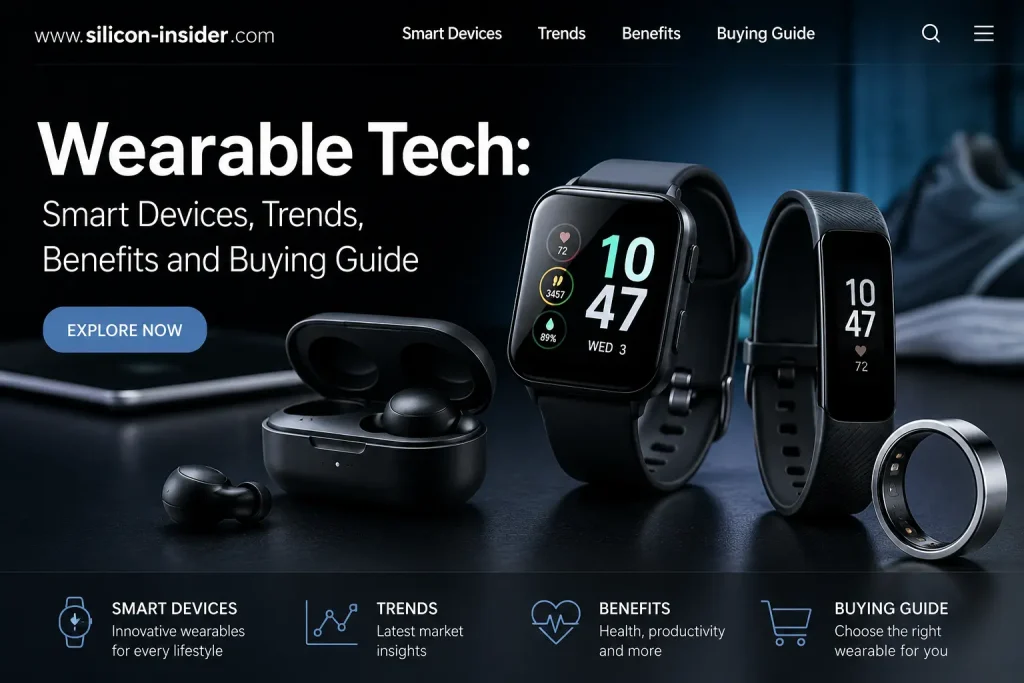
Wearable technology has moved far beyond simple step counters. Today, smartwatches, fitness bands, smart rings, connected glasses, intelligent earbuds, medical wearables, and sensor-equipped clothing can collect information, provide notifications, support fitness routines, and make everyday digital tasks more convenient.
People searching for www silicon-insider .com wearable tech are generally looking for information about wearable devices, their features, emerging technologies, and how different types of wearables fit into everyday life. Silicon Insider has a dedicated Wearable Tech category and publishes material covering smartwatches, fitness trackers, smart clothing, wearable electronics, and related technologies.
Understanding wearable technology is becoming more important as these devices combine health monitoring, communication, artificial intelligence, navigation, entertainment, and personal productivity in increasingly compact forms.
What Is Wearable Technology?
Wearable technology refers to electronic devices designed to be worn on or close to the body.
Unlike a traditional computer that stays on a desk, wearable devices are designed to remain with the user throughout the day. They may collect sensor data, connect to smartphones, display information, provide alerts, or automate small everyday tasks.
Common examples include:
- Smartwatches
- Fitness trackers
- Smart rings
- Smart glasses
- Wireless smart earbuds
- Smart clothing
- Wearable medical monitors
- Sleep trackers
- GPS sports watches
- Wearable safety devices
Silicon Insider’s overview similarly describes wearable technology as electronic devices incorporated into everyday life, including smartwatches, fitness trackers, and smart clothing.
Why Wearable Tech Has Become So Popular
Wearable devices offer something smartphones cannot always provide: continuous access without requiring users to repeatedly take a phone from their pocket.
A smartwatch can display a notification with a quick glance. A fitness tracker can record movement throughout the day. Smart glasses can place digital functions closer to a person’s natural field of view.
Several factors have helped wearable technology grow.
Convenience
Wearable devices are designed to remain readily accessible.
Instead of unlocking a phone for every small task, users may be able to:
- Check the time
- View notifications
- Control music
- Track exercise
- Set timers
- Receive navigation directions
- Answer calls
- Make contactless payments
The value often comes from reducing small amounts of friction throughout the day.
Better Sensors
Modern wearable devices can contain multiple sensors in a very small space.
Depending on the device, sensors may measure or estimate:
- Movement
- Heart rate
- Skin temperature
- Blood oxygen trends
- Sleep patterns
- Elevation
- Location
- Exercise intensity
The capabilities vary considerably between products, and consumer wearables should not automatically be treated as substitutes for professional medical equipment.
Greater Interest in Personal Health Data
Fitness trackers and smartwatches have made personal activity data easier to access.
Instead of only knowing that you exercised, a wearable may provide information about duration, pace, distance, heart-rate trends, and recovery-related measurements.
For many users, seeing progress over time can make fitness goals easier to understand.
Main Types of Wearable Technology
Wearable technology is a broad category. Different devices solve very different problems.
Smartwatches
Smartwatches are among the most versatile wearable devices.
They typically combine traditional watch functions with smartphone-style features.
Common smartwatch capabilities include:
- Notifications
- Fitness tracking
- GPS
- Heart-rate monitoring
- Music controls
- Calls and messaging
- Mobile payments
- Apps
- Sleep tracking
- Workout modes
Smartwatches are usually best for people who want one wearable capable of handling several tasks.
Fitness Trackers
Fitness bands generally focus more heavily on activity tracking than general computing.
They may measure:
- Steps
- Distance
- Calories
- Workouts
- Heart-rate trends
- Sleep
- Activity goals
Fitness trackers are often smaller and simpler than full smartwatches.
For users primarily interested in exercise and daily activity, the simplicity can be an advantage.
Smart Rings
Smart rings have become an increasingly interesting alternative to wrist-based wearables.
They fit many sensors into a small ring-shaped device and typically focus on passive tracking.
Common uses include:
- Sleep tracking
- Activity monitoring
- Recovery insights
- Heart-rate trends
- Temperature-related measurements
Because smart rings have smaller displays or no display at all, most information is viewed through a companion smartphone app.
Their main advantage is discreet continuous wear.
Smart Glasses
Smart glasses attempt to bring digital functionality directly into eyewear.
Depending on the design, features may include:
- Cameras
- Speakers
- Voice assistants
- Notifications
- Navigation
- Photography
- AI assistance
- Augmented-reality elements
Smart glasses are also creating important conversations about privacy because camera-equipped glasses may capture information about people surrounding the wearer. Recent reporting has highlighted continuing debate over recording, surveillance, and privacy concerns surrounding increasingly capable smart glasses.
Smart Earbuds and Hearables
Wireless earbuds are becoming more intelligent.
Beyond playing audio, some modern hearables may provide:
- Voice-assistant access
- Adaptive noise cancellation
- Conversation enhancement
- Fitness-related sensors
- Translation features
- Hearing assistance
- Spatial audio
Because earbuds already have a natural position near the ears and head, they can become useful platforms for additional sensing and AI features.
Smart Clothing
Smart clothing incorporates electronic sensors or conductive materials into garments.
Potential applications include:
- Athletic performance measurement
- Posture monitoring
- Movement analysis
- Temperature control
- Rehabilitation
- Workplace safety
Silicon Insider’s wearable electronics coverage also identifies smart clothing as one of the major forms of wearable technology.
Wearable Medical Devices
Healthcare-related wearables represent one of the most important areas of wearable technology.
Examples can include:
- Continuous glucose monitors
- ECG-capable devices
- Heart monitors
- Wearable medication systems
- Patient-monitoring sensors
- Fall-detection devices
There is an important distinction between consumer wellness wearables and regulated medical devices.
A device marketed for general fitness should not automatically be relied upon for diagnosis or treatment.
Wearable Tech Categories Compared
| Wearable Type | Main Purpose | Typical Strength | Potential Limitation |
|---|---|---|---|
| Smartwatch | General smart features | Versatility | Frequent charging |
| Fitness tracker | Activity monitoring | Simple fitness tracking | Fewer advanced features |
| Smart ring | Passive health tracking | Small and discreet | Limited direct interaction |
| Smart glasses | Visual and AI assistance | Hands-free access | Privacy concerns |
| Smart earbuds | Audio and voice interaction | Convenient daily use | Small batteries |
| Smart clothing | Body and movement sensing | Integrated monitoring | Washing and maintenance |
| Medical wearable | Health monitoring | Specialized measurements | May require professional oversight |
How Wearable Technology Works
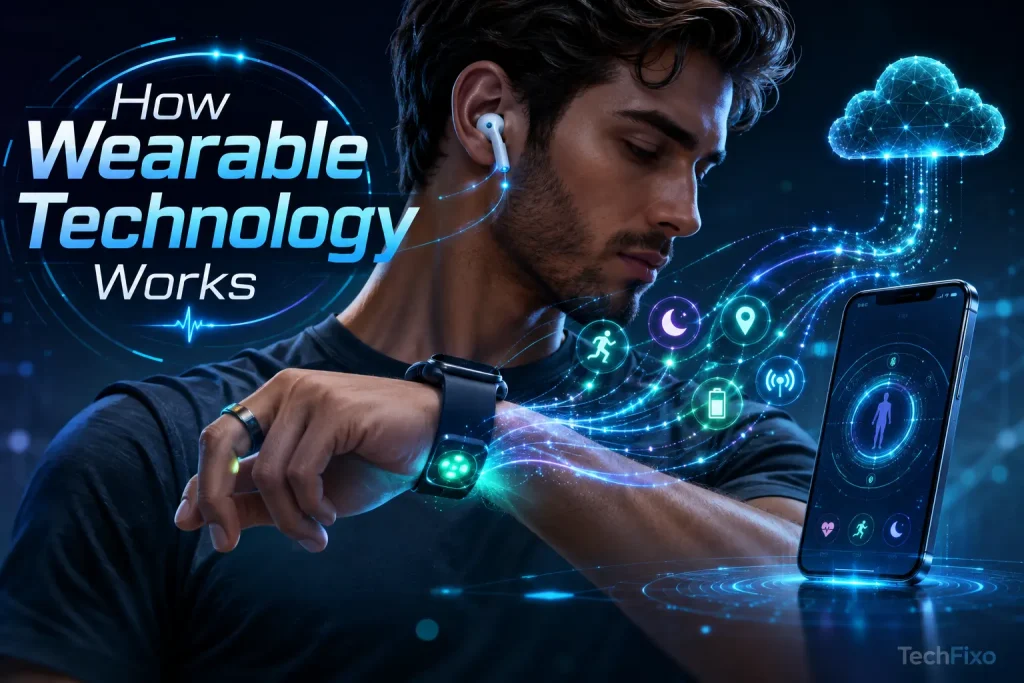
Most wearable devices rely on three major components:
- Sensors
- Software
- Connectivity
Sensors Collect Information
Sensors detect changes in the user’s movement, body, or surroundings.
For example, an accelerometer can detect motion while a GPS receiver can determine location.
Software Interprets the Data
Raw sensor readings are not very useful on their own.
Software turns those readings into understandable information such as:
- Step counts
- Running distance
- Sleep duration
- Workout summaries
- Activity trends
Different manufacturers can interpret similar sensor information differently, which is why measurements may vary between devices.
Connectivity Shares Information
Wearables often connect to smartphones using Bluetooth or Wi-Fi.
Some devices also include cellular connectivity, allowing them to work more independently.
Information may be synchronized with:
- Smartphone apps
- Cloud platforms
- Fitness services
- Health dashboards
- Other connected devices
Wearable Tech for Fitness and Exercise
Fitness remains one of the strongest use cases for wearable technology.
Athletes and casual exercisers can use wearables to record training sessions and review performance afterward.
Possible metrics include:
- Pace
- Distance
- Heart rate
- Workout duration
- Elevation
- Exercise zones
- Recovery estimates
- Route information
However, more data does not automatically result in better training.
Users still need to understand what the measurements mean and avoid becoming overly dependent on individual numbers.
Wearable Technology and Sleep Tracking
Sleep tracking has become a major feature of smart rings, fitness bands, and smartwatches.
Wearables may attempt to estimate:
- Sleep duration
- Bedtime
- Wake time
- Sleep stages
- Nighttime movement
- Resting heart rate
These features can be useful for identifying general patterns.
For example, a person might discover that their sleep duration regularly decreases during busy work periods.
However, consumer sleep trackers provide estimates rather than the same level of measurement available through clinical sleep testing.
Wearables and Personal Productivity
Wearables are not only fitness devices.
A smartwatch can reduce the need to constantly reach for a smartphone.
Users may receive:
- Calendar reminders
- Calls
- Messages
- Email alerts
- Timers
- Navigation directions
- Task notifications
The challenge is managing these features carefully.
A wearable that constantly vibrates with unnecessary notifications can become distracting rather than helpful.
Wearable Technology and Artificial Intelligence
Artificial intelligence is becoming increasingly important in wearable technology.
AI can help wearable devices interpret information rather than simply collect it.
Possible applications include:
- Voice assistants
- Real-time translation
- Context-aware recommendations
- Image recognition
- Personalized fitness insights
- Intelligent notification filtering
- Accessibility tools
Technology companies are also exploring AI-powered wearables as potential alternatives or complements to smartphones, particularly through smart glasses, earbuds, pins, and screen-light devices.
AI Smart Glasses
Smart glasses may become one of the most visible combinations of AI and wearable technology.
A camera, microphone, speakers, and AI system can potentially allow a wearer to ask questions about what they see.
Potential functions could include:
- Identifying objects
- Reading text
- Translating signs
- Giving directions
- Taking photos
- Answering contextual questions
Projects involving AI glasses are also being explored for accessibility, including systems that convert printed text into spoken information for visually impaired users.
Benefits of Wearable Technology
The value of wearable technology depends on how well a device fits into someone’s routine.
Continuous Monitoring
A wearable can collect information throughout the day without requiring continuous manual input.
Hands-Free Convenience
Wearables reduce dependence on physically holding another device.
Fitness Motivation
Activity goals, reminders, and progress tracking can encourage some users to stay active.
Faster Access to Information
Important notifications can be viewed quickly.
Safety Features
Some wearables provide:
- Emergency calling
- Fall detection
- Location sharing
- SOS functions
Personalization
Wearable devices can learn patterns and present information tailored to individual users.
Potential Disadvantages of Wearable Technology
Wearable devices also involve compromises.
Battery Life
More sensors and brighter displays usually require more power.
Depending on the device, users may need to charge it frequently.
A device becomes less useful if it spends too much time on a charger.
Data Accuracy
No wearable sensor is perfect.
Accuracy can be influenced by:
- Device placement
- Movement
- Skin contact
- Environment
- Sensor quality
- Software algorithms
Wearable measurements should therefore be interpreted as useful data points rather than unquestionable facts.
Comfort
A technically impressive device may still fail if users do not enjoy wearing it.
Important factors include:
- Weight
- Strap material
- Device thickness
- Heat
- Skin irritation
- Fit
Comfort becomes especially important for devices designed for sleep tracking or continuous monitoring.
Privacy
Wearables can collect highly personal information.
Depending on the device, this may involve:
- Location
- Health-related data
- Voice recordings
- Images
- Movement patterns
Users should understand what information is collected, where it is stored, and how it may be shared.
Cost
Premium wearable devices can be expensive.
The initial purchase price may also be accompanied by:
- Subscription fees
- Replacement accessories
- Premium app features
- Cellular plans
The most expensive device is not automatically the best choice for every user.
Privacy and Security in Wearable Tech
Privacy deserves special attention because wearable devices can continuously collect information.
Before buying a wearable, consider:
- What data does it collect?
- Is the data stored locally or online?
- Can tracking features be disabled?
- Does the device require an account?
- Can information be deleted?
- Does the company share data with third parties?
- Does the device contain a camera or microphone?
Camera-equipped wearables deserve particularly careful consideration because they can affect not only the wearer but also people nearby.
How to Choose the Right Wearable Device
A good buying decision starts with purpose.
Do not begin by asking which wearable has the most features.
Ask what you actually need it to do.
Define Your Main Goal
Your priorities may include:
- Fitness
- Sleep
- Running
- Productivity
- Navigation
- Health monitoring
- Music
- Communication
- Safety
Choosing one or two primary goals immediately narrows the options.
Check Compatibility
Wearables often work best within particular device ecosystems.
Before buying, confirm compatibility with your:
- Smartphone
- Operating system
- Fitness apps
- Health apps
- Music services
Compare Battery Life
Battery life can dramatically affect the ownership experience.
A fitness band lasting several days may suit someone who dislikes frequent charging, while another user may accept daily charging in exchange for a brighter display and more advanced features.
Consider Sensor Accuracy
If fitness tracking is your priority, sensor reliability deserves more attention than decorative features.
Silicon Insider’s recent wearable coverage emphasizes factors such as sensor accuracy, GPS performance, battery life, comfort, and price when discussing wearable devices.
Think About Comfort
Try to determine whether the device is suitable for:
- Everyday wear
- Exercise
- Sleeping
- Hot weather
- Long working days
A wearable cannot collect continuous information if it is uncomfortable enough that you repeatedly remove it.
Most Important Wearable Features Compared
| Feature | Why It Matters | Best For |
|---|---|---|
| GPS | Tracks outdoor location and routes | Runners and cyclists |
| Heart-rate sensor | Measures heart-rate trends | Fitness users |
| Sleep tracking | Estimates sleep patterns | Wellness tracking |
| NFC payments | Enables contactless payments | Everyday convenience |
| Cellular connection | Reduces phone dependence | Smartwatch users |
| Voice assistant | Provides hands-free interaction | Productivity |
| Water resistance | Supports swimming and outdoor use | Active users |
| Long battery life | Reduces charging frequency | Continuous tracking |
| AI features | Adds contextual assistance | Smart glasses and advanced wearables |
Wearable Tech vs Smartphones
Wearables are unlikely to make smartphones disappear immediately.
Instead, the two technologies often complement each other.
| Feature | Wearable Device | Smartphone |
|---|---|---|
| Portability | Excellent | Very good |
| Screen size | Small or absent | Large |
| Continuous sensing | Excellent | Moderate |
| Typing | Limited | Strong |
| Photography | Limited on most devices | Strong |
| Fitness tracking | Strong | Limited without wearable |
| Notifications | Quick glance | Full interaction |
| Battery capacity | Smaller | Larger |
| Hands-free use | Strong | Moderate |
The smartphone remains better for complex interaction, while wearables excel at quick access and continuous sensing.
Smartwatch vs Fitness Tracker
Choosing between these two popular wearable categories depends largely on how much functionality you want.
Choose a Smartwatch If You Want:
- Apps
- Calls
- Messaging
- Music controls
- Navigation
- Payments
- Advanced notifications
Choose a Fitness Tracker If You Want:
- Simpler activity tracking
- Smaller size
- Longer battery life
- Fewer distractions
- Basic workout monitoring
Neither category is universally better.
The right choice depends on how you intend to use it.
Smart Ring vs Smartwatch
Smart rings and smartwatches approach wearable technology differently.
A smartwatch encourages interaction.
A smart ring is typically designed to work quietly in the background.
A smart ring may suit someone who values:
- Discreet design
- Sleep tracking
- Passive monitoring
- Minimal notifications
A smartwatch may be better for someone who wants:
- A display
- Apps
- Messages
- Calls
- Navigation
- Workout controls
What Makes a Good Wearable Tech Product?
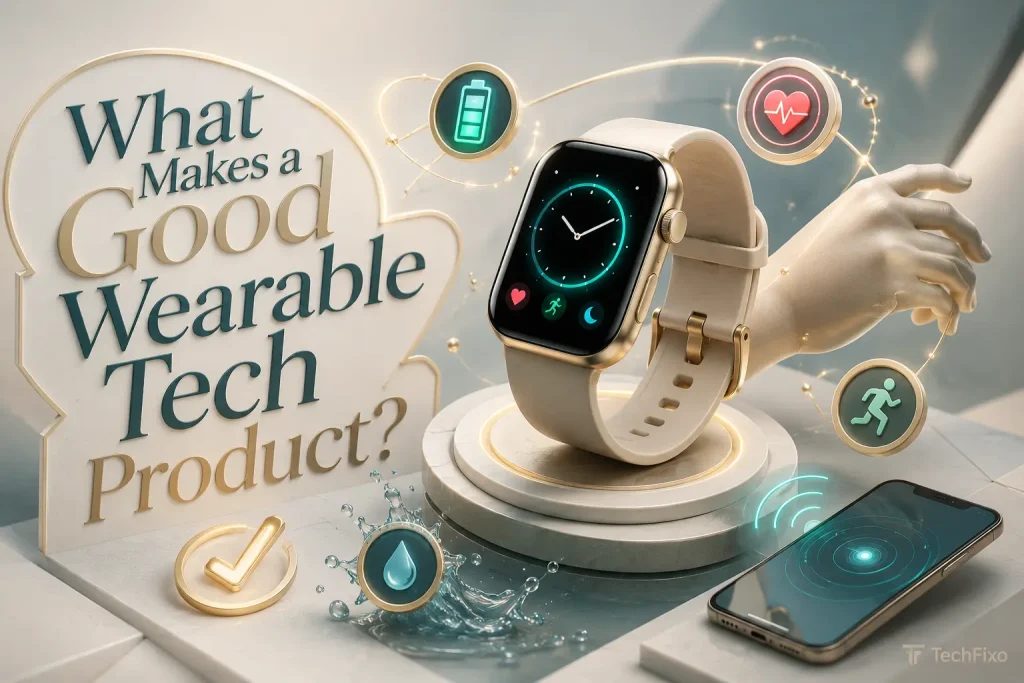
The strongest wearable device is not necessarily the product with the longest feature list.
A useful wearable should balance:
- Accuracy
- Battery life
- Comfort
- Ease of use
- Privacy
- Compatibility
- Durability
- Useful features
- Price
A device that performs five important tasks reliably may provide greater value than one advertising dozens of features that the owner rarely uses.
Common Mistakes When Buying Wearable Technology
Buying for Features You Will Never Use
Large feature lists look impressive in advertisements.
Focus instead on functions that fit your daily routine.
Ignoring Battery Life
Consider how often you are realistically willing to charge another device.
Assuming Every Health Reading Is Medical Grade
Consumer wearables can provide valuable insights, but their features and regulatory status vary.
Ignoring Subscription Costs
Some advanced analytics may require recurring payments.
Check this before purchasing.
Choosing Style Over Comfort
A wearable spends hours against the body.
Comfort should be considered just as carefully as appearance.
Ignoring Privacy Settings
Review permissions when setting up the device instead of automatically accepting every option.
Where Wearable Technology Is Heading
The direction of wearable technology is increasingly toward devices that require less deliberate interaction.
Future wearables are likely to focus more heavily on:
- AI assistance
- Smaller sensors
- Context awareness
- Improved battery efficiency
- Smart glasses
- Advanced health monitoring
- Accessibility
- Voice interaction
- Environmental sensing
The long-term goal appears to be making technology feel less like something users constantly operate and more like something that quietly assists them when needed. Current industry interest in AI wearables and smart glasses reflects that broader direction.
Why www silicon-insider .com Wearable Tech Attracts Interest
The keyword www silicon-insider .com wearable tech reflects growing interest in finding understandable information about connected devices and emerging wearable technologies.
Silicon Insider maintains a dedicated Wearable Tech section, with coverage that includes general wearable technology, wearable electronics, smartwatches, smart clothing, smart glasses, and other connected devices.
For readers researching wearable technology, the most useful approach is to look beyond product hype and examine practical factors such as accuracy, battery life, comfort, privacy, compatibility, and real everyday usefulness.
Frequently Asked Questions
What is www silicon-insider .com wearable tech?
The phrase refers to searches related to wearable technology information associated with Silicon Insider. The website maintains a Wearable Tech category covering connected devices and related technology topics.
What is wearable technology?
Wearable technology includes electronic devices designed to be worn on or close to the body, such as smartwatches, fitness trackers, smart rings, smart glasses, smart clothing, and medical wearables.
What are the most common wearable devices?
Smartwatches and fitness trackers are among the most familiar examples, while smart rings, smart glasses, intelligent earbuds, smart clothing, and specialized medical devices represent other important categories.
What is wearable technology used for?
Wearable devices can support fitness tracking, communication, navigation, health monitoring, entertainment, productivity, safety, and hands-free access to digital information.
Are wearable health trackers accurate?
Accuracy varies depending on the sensor, device, measurement type, fit, and software. Consumer wearables can be useful for monitoring general trends but should not automatically be treated as professional medical equipment.
Is a smartwatch better than a fitness tracker?
A smartwatch is usually better for users wanting apps, communication, navigation, and broader functionality. Fitness trackers are often better for people who prefer simpler activity tracking and potentially longer battery life.
What is the advantage of a smart ring?
Smart rings provide discreet passive tracking in a compact design. They are commonly suited to users who want sleep, recovery, and activity information without wearing a full smartwatch.
Are smart glasses wearable technology?
Yes. Smart glasses are wearable devices that may combine cameras, audio, AI assistance, communications, navigation, or augmented-reality capabilities.
Can wearable technology improve fitness?
Wearables can help users track activity, workouts, distance, pace, and other trends. Whether those measurements improve fitness depends on how the user applies the information.
Is wearable technology safe?
Most consumer wearables are intended for routine everyday use, but users should consider privacy, skin comfort, battery safety, data security, and appropriate use of health-related measurements.
What should I look for before buying wearable tech?
Consider the device’s purpose, comfort, battery life, sensor performance, smartphone compatibility, privacy controls, durability, ongoing subscription costs, and overall price.
Will wearable technology replace smartphones?
Wearables may reduce how often people need to interact with smartphones for certain tasks, but smartphones remain better suited to larger screens, typing, complex applications, and many forms of content creation.
Conclusion
The growing interest around www silicon-insider .com wearable tech reflects how quickly wearable devices are becoming part of everyday technology.
Smartwatches and fitness trackers established the category, but wearable technology now extends to smart rings, connected glasses, intelligent earbuds, smart clothing, health-monitoring devices, and emerging AI-powered products.
The most important question is no longer whether a wearable has the largest number of features. A better question is whether those features genuinely improve the user’s daily routine.
Battery life, sensor accuracy, comfort, privacy, compatibility, durability, and practical usefulness should all be considered before choosing a device.
As sensors become smaller and artificial intelligence becomes more deeply integrated into personal devices, wearable technology is likely to become increasingly capable while demanding less direct interaction from users. The most successful wearables will be those that provide useful information and assistance without becoming another source of unnecessary complexity.